Real results from a Toronto law firm engagement, built on the same system we bring to Vancouver — read the full case study →
Why Vancouver Law Firms Need More Than a Template Website
Walk through ten Vancouver law firm websites and you'll mostly find two patterns repeating: a stock legal template with the firm's logo dropped in, or a site clearly built for an Ontario client and never actually adapted — still referencing the wrong tenancy statute, silent on the Civil Resolution Tribunal, describing real estate closing timelines that don't match how a BC transaction actually moves. Neither one gives an AI crawler what it needs — clean semantic HTML, working schema markup, a page that loads fast, and signals specific enough to say with confidence who you are, what you practice, and why a British Columbia client should trust you over the firm next door. See why law firms need AI-optimized websites in 2026 for the fuller picture of why this shift matters.
This page covers what an AI-optimized website actually requires, and how it connects to AI SEO for Vancouver law firms, the visibility strategy that determines whether anyone ever finds that website in the first place.
Template Website vs. AI-Optimized Website
A website that gets British Columbia law wrong — citing an Ontario tenancy rule, or a small-claims process that doesn't apply here — doesn't just lose a client's trust. It tells an AI system this firm isn't a reliable source, and that's a much harder thing to undo.
James Harmiden · Founder & CEO, Lexscale.ai
What Makes a Website "AI-Optimized" in 2026
Strip away the jargon and an AI-optimized website rests on one idea: an AI crawler and a stressed-out visitor at 11pm need to reach the same conclusion, fast — who you are, what you handle, and why you can be trusted with it. In practice that means headings that say exactly what's on the page instead of clever wordplay, and structured data that spells out your firm's name, practice areas, service area, and credentials directly, rather than making a crawler guess at it from paragraphs of prose.
It also means writing with real depth about what actually sends a Vancouver client looking for a lawyer — a high-value property closing, an estate plan built around a home that's appreciated into seven figures, a strata council fight, a Residential Tenancy Branch hearing. Three paragraphs of generic practice-area copy give an AI system nothing specific enough to stake a citation on.
Why a Slow Vancouver Firm Site Costs More Than Patience
None of the content or technical work matters much if the page itself crawls to load. Core Web Vitals are a direct Google ranking factor on their own, and a slow site also gets crawled less often and less thoroughly by the AI systems trying to build a picture of what's actually on the page — so speed problems compound instead of just annoying an impatient visitor.
Most of the older law firm websites we see in this market are running on a content management system that's accumulated years of plugins nobody remembers installing and images nobody ever compressed. Rebuilding for AI means cutting that dead weight out at the root — purpose-built code instead of a general-purpose CMS dragging along features a law firm site was never going to touch.
Building a Page Structure AI Systems Can Actually Follow
AI systems don't just read a website's words, they parse its skeleton — one H1 that actually states the page's topic, H2s that mark real structural breaks rather than being sprinkled in for looks, and internal links that connect related ideas the way a knowledgeable colleague would: a real estate page pointing to a strata dispute FAQ, which in turn points to a guide on BC closing costs. Done well, that turns a website into a topic cluster an AI system can walk through as one connected body of expertise instead of a pile of disconnected pages. If you're wondering how much structure a site actually needs, how many pages a Vancouver law firm website should have is a good place to start.
It also means resisting the temptation to render everything in JavaScript and hope a crawler sorts it out. Whether a crawler fully executes your scripts is not a bet worth making with your firm's name, practice areas, service area, or phone number — those need to sit in the actual HTML markup, visible the instant the page loads, not assembled client-side after the fact.
Schema Markup for Vancouver Law Firm Websites
Think of schema markup as translation — it takes what's on a page and states it in a format search engines and AI systems can read as fact rather than infer from context. For a Vancouver firm, that typically means LegalService schema describing the firm itself, Attorney or Person schema for each lawyer with sameAs links out to their Law Society of British Columbia profile and LinkedIn, FAQPage schema mirroring the FAQ content actually visible on the page, and BreadcrumbList schema that maps how the site fits together.
It's also the piece we most consistently find missing or half-done when we audit a Vancouver firm's site — see what schema markup is and why a Vancouver law firm's website needs it for the full breakdown. Get it right and you've handed AI systems the exact structured facts they use to decide how much to trust an entity — which is a large part of whether they cite you at all. This is one of the clearest places where website architecture and AI SEO strategy are really the same work wearing two different hats.
Conversion Design for a High-Asset, Multicultural Client Base
Getting found is only half the job — a page that ranks perfectly and converts nobody is a wasted opportunity; our law firm website conversion optimization guide covers the mechanics in full. For a Vancouver firm that means an obvious, frictionless way to make contact on every single page, and the right trust signals sitting exactly where a hesitant visitor needs them — credentials, case results phrased to stay inside Law Society of British Columbia rules, and a plain, honest account of what actually happens after someone submits that form.
It also means designing with Vancouver's genuinely diverse client base in mind — clear, accessible language, and where relevant, multilingual considerations that reflect the city's large Chinese-Canadian and South Asian communities, rather than assuming a single default client profile. High-value real estate and estate matters in particular tend to involve clients who research extensively before reaching out, so the website needs to hold up to real scrutiny.
Mobile-First Design for a Transit-Heavy City
A significant share of legal searches in Vancouver happen on mobile devices, often on the SkyTrain, on a bus along the Broadway corridor, or in the moments after a stressful call. Build the site for a desktop monitor first and just let it "respond" on a phone, and you've put friction exactly where a rattled visitor has the least patience for it.
Designing mobile-first flips that — the phone number, the main call-to-action, and the contact form sit right where a thumb can find them without three taps through a hamburger menu, and the form itself is short enough to actually finish one-handed on a moving bus.
Law Society of British Columbia Advertising Compliance on Your Website
Every element of a Vancouver law firm's website — case results, testimonials, guarantees implied by headline copy, AI chatbot disclosures — needs to be reviewed against Law Society of British Columbia advertising rules before it goes live. This is a step a generalist web design agency working across many industries is unlikely to build into its process by default, and it's a different rulebook entirely from Ontario's.
Building compliance into the design process from the start protects a Vancouver firm from having to redo work later, and from the reputational risk of publishing marketing claims that don't hold up to LSBC standards.
Common Website Mistakes We Fix for Vancouver Firms
The most frequent issue is legal content that's factually wrong for British Columbia — Ontario tenancy timelines, small-claims dollar limits, or court names that don't exist here. Beyond the professional risk, AI systems are increasingly good at detecting jurisdictional mismatches, and it actively damages citation trust — the exact pattern we cover in is my current Vancouver law firm website losing me clients.
Second most common: contact details that don't match from one place to the next — a phone number in the footer that's a generation old, an address on the Google Business Profile that predates a move out of a shared Yaletown office. Small as it sounds, that mismatch chips away at the entity confidence both classic SEO and AI citation are built on.
Third is schema markup that's either missing entirely or was implemented once and never touched again — pages get rewritten, practice areas get added, and the structured data quietly falls out of sync with what's actually on the page.
Fourth, and easy to overlook: attorney bio pages built as an afterthought — two sentences and a headshot. A bio done properly, with sameAs links back to a Law Society of British Columbia profile and a genuinely specific account of the lawyer's experience, pulls far more weight for both AI citation and a prospective client's trust than most firms realize.
The ROI of an AI-Optimized Website for a Vancouver Firm
The immediate payoff shows up as a lower bounce rate once pages load fast, more consultations booked once the path to contact is actually clear, and every subsequent dollar spent on AI SEO working harder because the content it produces finally has a structurally sound place to live.
The less obvious payoff is that it holds up over time. A site built on lean, purpose-built infrastructure with real schema markup doesn't rot the way a generic template does, because it's built around principles — speed, clarity, structured data — that stay relevant even as ChatGPT, Gemini, and whatever comes next keep changing how they evaluate a page.
There is also a competitive dimension specific to a market where clients routinely have significant assets at stake. When a prospective client comparing several firms is deciding who to trust with a multi-million-dollar estate or real estate transaction, a noticeably faster, clearer, more credible website becomes a quiet but real differentiator.
Case Study · Toronto Law Firm
From a 140-Page WordPress Site to a 570-Page AI Legal Website
This is a Toronto engagement, not a Vancouver one — we don't yet have a published BC case study — but it's the same system we'd bring to a Vancouver firm. Lexscale.ai transformed this law firm's website from an approximately 140-page WordPress website into an approximately 570-page AI-ready legal website, adding practice-area depth, supporting legal insights, service-area content, legal calculators, interactive guided wizards, structured data, and strategic internal linking, on faster, purpose-built infrastructure.
The result: organic website traffic tripled within 90 days. Results vary by firm, market, and existing authority — but a Vancouver build follows the identical process, adapted for British Columbia law and Law Society of British Columbia compliance rather than Ontario's.
Since then, this same law firm's visibility in Google AI Overviews has grown from 4.9K to 82.5K impressions in 3 months — verified directly in Google Search Console.
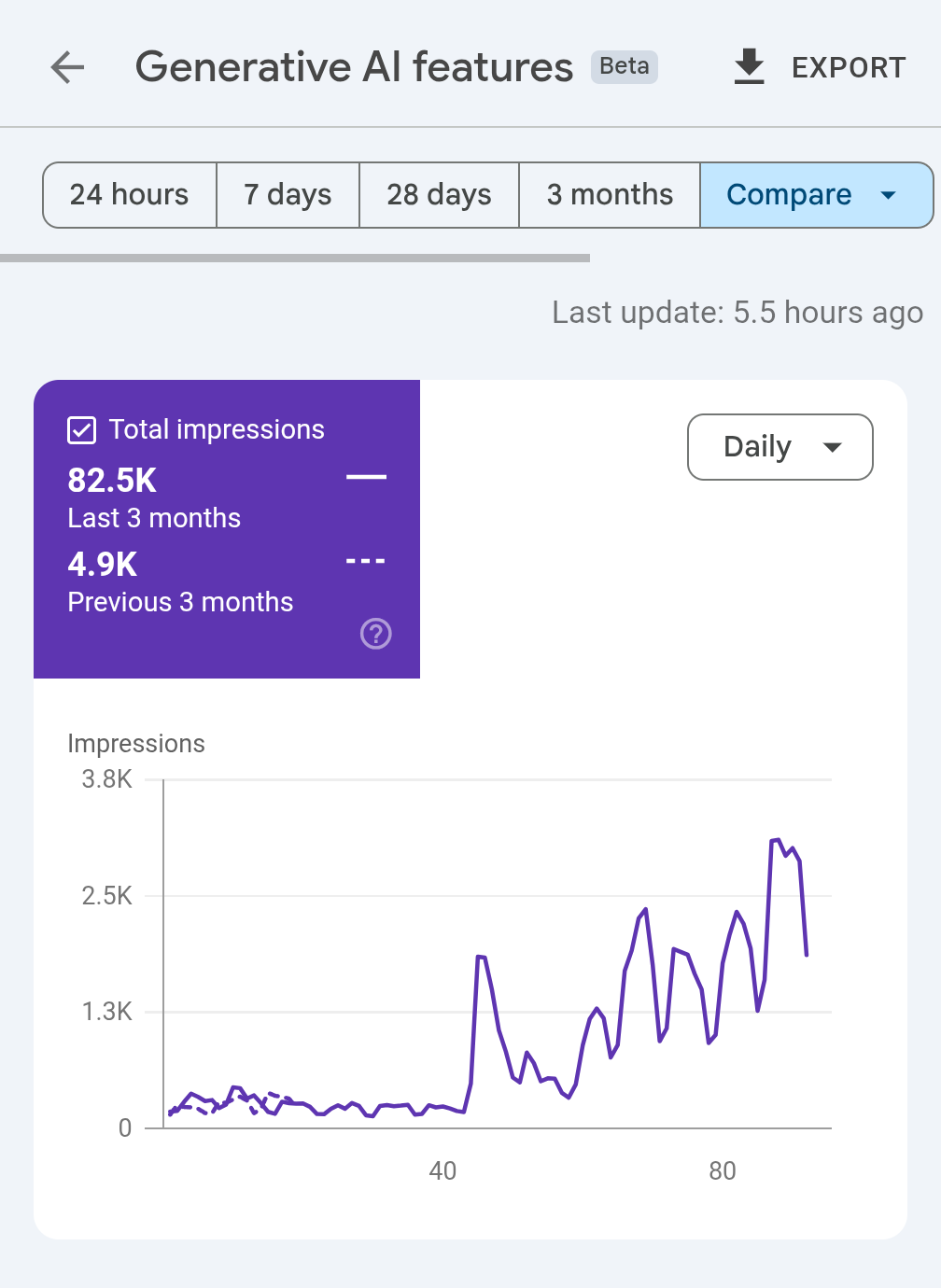
Source: Google Search Console — Generative AI features report, this law firm's own property.
Common Website Mistakes We Fix for Vancouver Firms — What They Cost
Duplicate practice area pages, inconsistent contact information, missing schema, thin attorney bios, and jurisdictionally inaccurate content don't just look unpolished — each is a specific, fixable reason an AI system chooses not to cite a firm. Fixing all of them is usually a matter of weeks, not months, once identified through a proper audit, but most Vancouver firms have never had one done, and many are still running on content written for a generic Canadian or Ontario audience.
Pairing Your Website With AI SEO for Vancouver Law Firms
A flawlessly built, fully schema-marked site is still just a well-built site nobody finds if nothing points people toward it. That gap is exactly what AI SEO for Vancouver law firms exists to close.
Both services are pulling from the same technical foundation, which is exactly why the firms that see the best results are the ones that don't treat the website build and the AI SEO strategy as separate purchases made months apart.
What to Expect in the First 90 Days
Every Vancouver engagement follows the same three-phase structure, so you always know what's happening and why. If you're trying to plan around a timeline, how long it actually takes to build an AI-optimized website in Vancouver walks through each phase below in more detail.
Post-launch, most Vancouver firms move directly into an ongoing AI SEO engagement, since a freshly launched website is exactly when a coordinated visibility push delivers the fastest returns.
What the Build Process Looks Like
Every Vancouver website engagement starts with an audit of your current site against the technical, content, and compliance standards above, followed by a strategy call to map out priorities. From there, Lexscale.ai handles the design, build, schema implementation, and Law Society of British Columbia-compliant copywriting directly — the same process used across our broader AI website design work for law firms across North America, adapted specifically for the Vancouver market.
Most Vancouver engagements move from initial call to a fully launched, AI-optimized website within a few weeks, followed by an ongoing relationship focused on AI SEO and content growth. If you want to see a broader Vancouver AI growth strategy before committing to the website build alone, the Vancouver AI growth hub is the best starting point.
Related Reading: AI Website Design Insights
Vancouver Insights: Questions Answered Directly
From My Experience — James Harmiden
A lot of the Vancouver law firm sites I look at were clearly built by someone who'd never spent time around the tech companies clustered a few blocks away in Yaletown and around False Creek. That matters more here than in most cities, because a meaningful share of the people evaluating a Vancouver firm — whether it's a startup founder needing a commercial lawyer or someone comparing firms after a car accident — work in an industry that treats a slow, dated website as an immediate red flag.
I've rebuilt enough of these WordPress sites to know exactly what I'll find before I open the inspector: a theme built for generic small business, years of accumulated plugin weight, and schema markup that either doesn't exist or was implemented once years ago and never touched again — the exact migration is covered in how to move a Vancouver law firm website off WordPress without losing your Google rankings. None of that holds up next to the standard this city's audience has come to expect from literally everything else they interact with online.
What I build instead is fast, structurally sound, and honest about what it is — and the difference in results is rarely subtle. Firms consistently get more out of a properly built site than they ever got from years of paying an agency to maintain a WordPress install that was quietly working against them the entire time.
— James Harmiden, Founder & CEO, Lexscale.ai