Real results from a Toronto law firm engagement, built on the same system we bring to Vancouver — read the full case study →
Why Traditional SEO Isn't Enough for Vancouver Law Firms Anymore
Backlinks, keyword density, domain authority — the old SEO toolkit hasn't disappeared, but it was designed for a world where someone typed a phrase into a search box and scrolled down a page of blue links to find an answer. That's a shrinking share of how Vancouver clients actually research a legal problem today. Increasingly, Google's AI Overviews, ChatGPT, Gemini, and Perplexity just answer the question outright, naming a handful of trusted sources along the way, before the person ever lands on a conventional results page.
For a Vancouver firm, chasing rankings for "Vancouver personal injury lawyer" and a handful of city-name variants is optimizing for a slice of search that keeps getting smaller. What actually earns a citation inside an AI-generated answer is a different set of ingredients entirely — structured data, entity signals, and content with enough real depth to be worth quoting. And that work runs directly into AI website design for Vancouver law firms, because both disciplines are standing on the same technical foundation.
Traditional SEO vs. AI SEO
Getting British Columbia law right isn't optional content polish — it's the difference between an AI system citing your firm as an authority and quietly filtering you out for being wrong.
James Harmiden · Founder & CEO, Lexscale.ai
How Google AI Overviews Are Reshaping Vancouver Legal Searches
Google AI Overviews now appear above traditional results for a large share of informational legal queries — questions about strata disputes, Residential Tenancy Branch process, or what happens to a house in a high-value divorce. These synthesized answers cite a handful of sources directly beneath the summary, and appearing in that citation list puts a Vancouver firm in front of a prospective client before they've even scrolled to a traditional result.
Earning that citation slot takes content that answers the actual question head-on, not around it, and stands on clear E-E-A-T footing — real experience, real expertise, demonstrated authority, and trustworthiness that holds up to scrutiny. Thin content, generic content, or content that gets British Columbia's rules wrong gets passed over almost every time, no matter how precisely it was built to hit a keyword.
Getting Cited in ChatGPT and Perplexity as a Vancouver Firm
The mechanics behind ChatGPT and Perplexity differ from how Google assembles an AI Overview, but the logic underneath is the same — both are reaching for sources they've already decided are authoritative and squarely on-topic for the question being asked. For a Vancouver firm, that means the content on your site has to be specific enough, structured enough, and accurate enough about British Columbia law that one of these systems can confidently point to your firm by name.
Attorney bios with genuine credentials and sameAs links to verifiable external profiles, FAQ content matching real client questions, and practice-area pages with jurisdiction-specific detail about BC law all meaningfully increase the odds of citation.
Entity SEO: Building Authority Signals AI Systems Trust
Entity SEO comes down to building a digital identity for your firm and its lawyers that's verifiable and cross-referenced enough that AI systems and search engines can confirm it's real, rather than take your word for it.
That web of cross-references is precisely how an AI system convinces itself an entity is real, verified, and worth citing. It's also why a firm with a modest content library but rock-solid entity signals regularly outperforms a firm that's published twice as much content on a shaky, inconsistent foundation.
Building entity authority is not a one-time task. As a Vancouver firm adds lawyers or updates its address, every one of those changes needs to propagate consistently across the website, schema markup, GBP listing, and any legal directories the firm is listed in.
Content Strategy for Vancouver's Distinct Legal Market
Vancouver's legal market is distinct enough from the rest of Canada that generic, national content simply does not compete. An effective AI SEO content strategy for a Vancouver firm is built around topical clusters that reflect the city's actual client base: real estate and estate planning content for a market with some of the highest property values in North America, strata and Residential Tenancy Branch content, and employment and commercial content for the film production and technology sectors clustered downtown and around False Creek.
Content also needs to be genuinely useful and jurisdictionally accurate — realistic timelines, honest caveats about outcomes, and specific references to British Columbia statutes and the Civil Resolution Tribunal or Residential Tenancy Branch process, not generic "Canadian" legal information that quietly gets details wrong.
Prioritization matters too. Rather than attempting to build every possible practice area cluster simultaneously, the strongest results usually come from picking the one or two practice areas that represent the highest-value client work for a given Vancouver firm — often real estate or estate planning, given the market — and building genuine depth there first.
This is also where getting the jurisdiction right pays off directly: content that correctly explains Residential Tenancy Branch process or Civil Resolution Tribunal procedure faces far less entrenched, high-quality competition than generic Canadian legal content, where dozens of national sites are already publishing at volume.
Schema Markup and Structured Data Essentials
An AI system doesn't take a firm's word for anything — it checks the structured data behind the page. For a Vancouver firm that's LegalService or ProfessionalService schema on the firm itself, Attorney or Person schema per lawyer, FAQPage tags matching the visible FAQ content exactly, BreadcrumbList sitewide, and Article schema with accurate dates on every insight piece.
That markup gets built alongside the site's actual structure, not bolted on afterward — AI website design for Vancouver law firms covers how the two fit together.
Google Business Profile Optimization for Metro Vancouver
Google Business Profile is still a critical piece of visibility for any Vancouver firm — it feeds traditional local search and, increasingly, AI-driven local recommendations too. Getting it right means categories that actually match your practice areas rather than a generic "lawyer" tag, service and attribute fields filled in completely instead of left blank, and reviews coming in at a steady, genuine pace rather than a burst once a year.
That GBP data feeds straight into the entity-confidence calculation AI systems run before deciding whether to cite a firm. Making sure the listing actually matches your website's schema markup is one of the highest-leverage, lowest-effort fixes available — and it's one almost no Vancouver firm has ever actually checked.
Digital PR and Backlinks in the Vancouver Legal Community
A link from a source that's genuinely relevant and genuinely authoritative still carries real weight, for classic SEO and for AI citation confidence alike. For a Vancouver firm that usually looks like a byline in a BC legal or business publication, guest commentary when a real estate or tenancy law story breaks, a speaking engagement that gets written up online, or a referral partner who links back as a matter of course.
A single well-placed feature in a respected legal or business publication typically outweighs dozens of low-quality directory listings, both in traditional ranking impact and in the entity credibility it lends a Vancouver firm. Generic, low-quality directory backlinks carry little weight in an AI SEO strategy and are frequently discounted entirely by modern algorithms.
Given Vancouver's concentration of film, tech, and international trade companies, there is also a real opportunity in relationships with in-house counsel and business contacts at firms clustered around False Creek and the port — the kind of professional network that tends to produce genuine referral links rather than paid placements.
Law Society of British Columbia Compliance for AI-Generated Content
Any Vancouver firm using AI tools to help produce content needs a compliance layer between generation and publication. The Law Society of British Columbia's advertising rules apply regardless of whether a human or an AI tool drafted the initial copy — and content generated with a national or Ontario-trained model needs specific review to make sure BC-specific legal details are actually correct, not just plausible-sounding.
In practice, this means every piece of AI-assisted content passes through a review step that checks it against LSBC advertising standards and BC legal accuracy before publication, the same way a firm would review copy drafted by a junior associate.
Measuring AI SEO Success: What to Track
You can't measure AI SEO the way you measure traditional SEO, because getting cited inside an AI-generated answer doesn't leave behind a clickable, trackable link the way a search result does. What actually tells you something: manually checking whether your firm gets named when you run your target queries through ChatGPT, Gemini, and Perplexity, watching for appearances in Google's AI Overviews, tracking growth in direct and branded search traffic, and simply asking new consultations how they found you.
How often you look matters as much as what you look at. A single snapshot tells you almost nothing; a monthly review that shows the trend line tells you a lot, because both traditional rankings and AI citation bounce around week to week even when the real direction is up. Any Vancouver firm vetting an AI SEO partner should ask them, specifically, how they track and report citation and visibility — a vague answer is a red flag.
Case Study · Toronto Law Firm
From a 140-Page WordPress Site to a 570-Page AI Legal Website
This is a Toronto engagement, not a Vancouver one — we don't yet have a published BC case study — but it's the same system we'd bring to a Vancouver firm. Lexscale.ai transformed this law firm's website from an approximately 140-page WordPress website into an approximately 570-page AI-ready legal website, adding practice-area depth, supporting legal insights, service-area content, legal calculators, interactive guided wizards, structured data, and strategic internal linking, on faster, purpose-built infrastructure.
The result: organic website traffic tripled within 90 days. Results vary by firm, market, and existing authority — but a Vancouver AI SEO engagement follows the identical process, adapted for British Columbia law and Law Society of British Columbia compliance.
Since then, this same law firm's visibility in Google AI Overviews has grown from 4.9K to 82.5K impressions in 3 months — verified directly in Google Search Console.
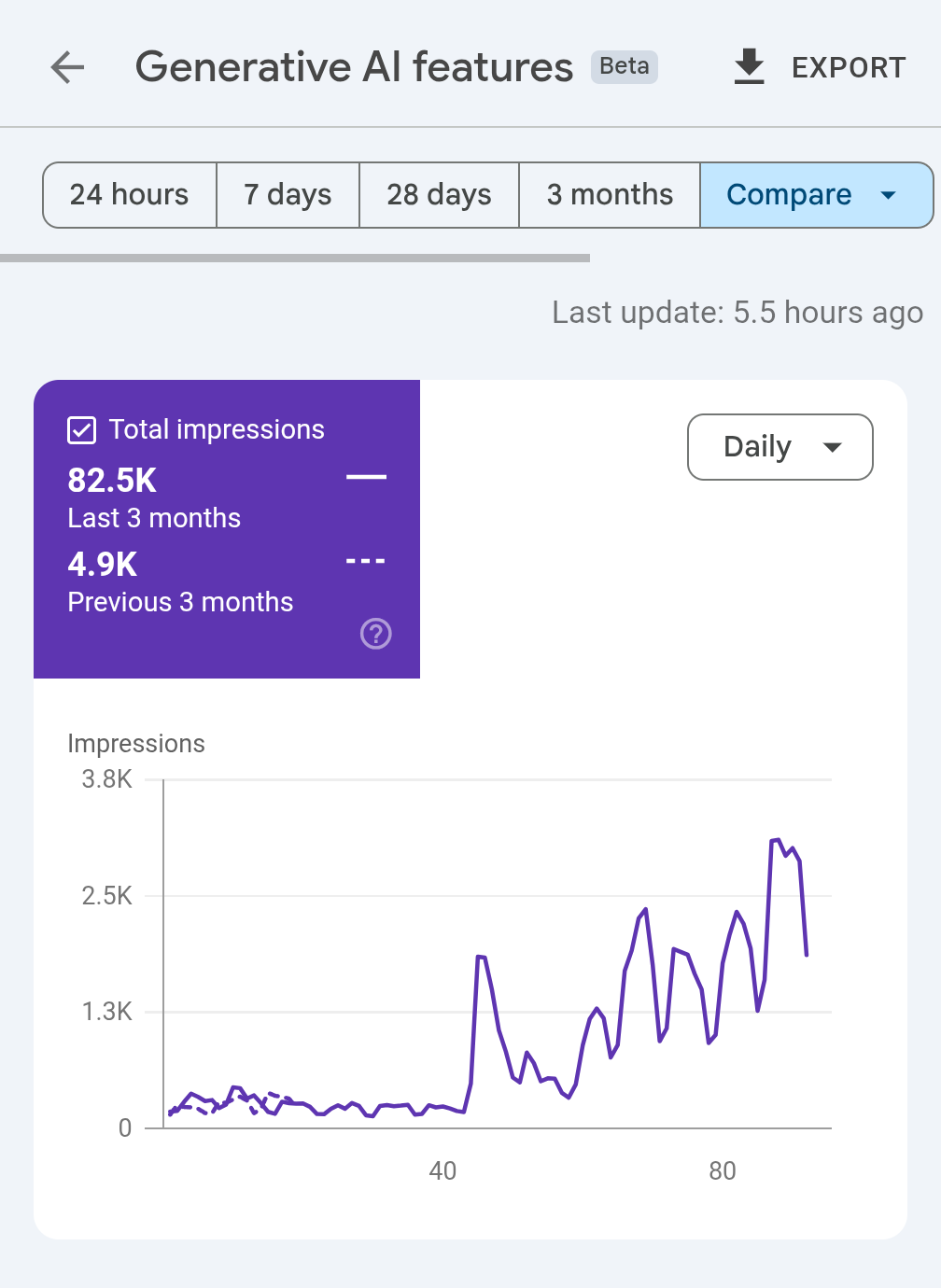
Source: Google Search Console — Generative AI features report, this law firm's own property.
Common AI SEO Mistakes Vancouver Firms Make
The costliest mistake is bolting AI SEO tactics onto a firm with no entity foundation underneath — publishing FAQ pages and adding schema markup while the firm's name and phone number still don't match across the web, or while attorney bios list a name and nothing else verifiable.
A second common mistake is publishing content that's legally inaccurate for British Columbia because it was written, or AI-generated, without BC-specific review — citing Ontario tenancy or small-claims rules that don't apply here. AI systems are increasingly capable of flagging jurisdictional mismatches, which actively works against a Vancouver firm's citation goals.
Third: giving up too soon. AI SEO compounds the same way traditional SEO does — slowly, then more visibly — and firms that pull the plug after six weeks because they haven't seen a dramatic jump are usually quitting right before the curve starts to bend.
Pairing AI SEO With an AI-Optimized Website
Pour an AI SEO strategy onto a slow, poorly structured website and you'll hit a ceiling fast, no matter how good the content is — the foundation caps the return. That's the whole reason AI SEO for Vancouver law firms is built to run alongside, not instead of, AI website design for Vancouver law firms.
If your firm's site is already fast and properly structured, there's no reason to wait — AI SEO can start on its own. The Vancouver AI growth hub walks through how to tell which one your firm actually needs first.
Related Reading: AI SEO Insights
Vancouver Insights: Questions Answered Directly
From My Experience — James Harmiden
British Columbia's legal search landscape has more moving pieces than almost anywhere else I work, and most firms here are only watching one of them. ICBC's monopoly on basic auto insurance means personal injury searches follow a completely different pattern than in a province with open competition — people are asking very specific questions about a single insurer, not comparing carriers. The Civil Resolution Tribunal pulls a huge volume of smaller disputes — strata issues, claims up to five thousand dollars — into a process most people have never heard of until they need it, and they're asking an AI system to explain it before they ever call a lawyer.
I've watched Vancouver firms build a reasonably solid Google ranking and assume that's the whole job, while missing that the same prospective client is also checking Google Maps from a phone in Gastown, or asking ChatGPT to explain how the CRT actually works before deciding whether they even need representation. Optimizing for one of those and ignoring the others leaves real clients on the table.
AI is where this is heading regardless of what any individual firm decides to do about it. I built the SEO side of this business to cover BC's actual legal landscape — ICBC, the CRT, the foreign buyer tax, all of it — across Google Maps, Google search, and AI search at once, because that's the market as it actually exists, not the generic version most SEO strategies are still built for.
— James Harmiden, Founder & CEO, Lexscale.ai