Real results from a Toronto law firm engagement — read the full case study →
An AI Website Is Not a Site Full of Auto-Generated Content
An "AI website" does not mean a low-quality site padded with automatically generated text. For a Toronto law firm, it means a modern legal website built with strong technical architecture, real practice-area and supporting content clusters, legal calculators and guided tools, structured data and entity signals, fast page performance, and layouts designed to convert — engineered for how both Google and AI systems like ChatGPT, Gemini, and Perplexity actually evaluate a law firm's website today. See why law firms need AI-optimized websites in 2026 for the fuller picture of why this shift matters.
Why Traditional Toronto Law Firm Websites Underperform
Most Toronto law firm websites we audit share the same handful of problems, and they compound each other — often to the point that a firm's own website is quietly losing it clients without anyone realizing the site itself is the bottleneck.
The Lexscale.ai AI Website System
Every Lexscale.ai website for a Toronto law firm is built around the same connected system.
The outcome we're building toward is qualified visibility, authority, and inquiries — not just a website that looks good in a screenshot. Conversion design in particular is worth getting right; see our law firm website conversion optimization guide for what that actually involves.
Case Study · Toronto Law Firm
From a 140-Page WordPress Site to a 570-Page AI Legal Website
Lexscale.ai transformed this law firm's website from an approximately 140-page WordPress website into an approximately 570-page AI-ready legal website — adding detailed practice-area content, supporting legal insights, Toronto and GTA service content, legal calculators, interactive guided wizards, improved technical architecture, structured data, and strategic internal linking, on faster, more scalable infrastructure.
The result: organic website traffic tripled within 90 days. Results vary by firm depending on competition, market, existing authority, and how a strategy is implemented — but this is the kind of outcome a properly structured AI website can make possible.
Since then, this same law firm's visibility in Google AI Overviews has grown from 4.9K to 82.5K impressions in 3 months — verified directly in Google Search Console.
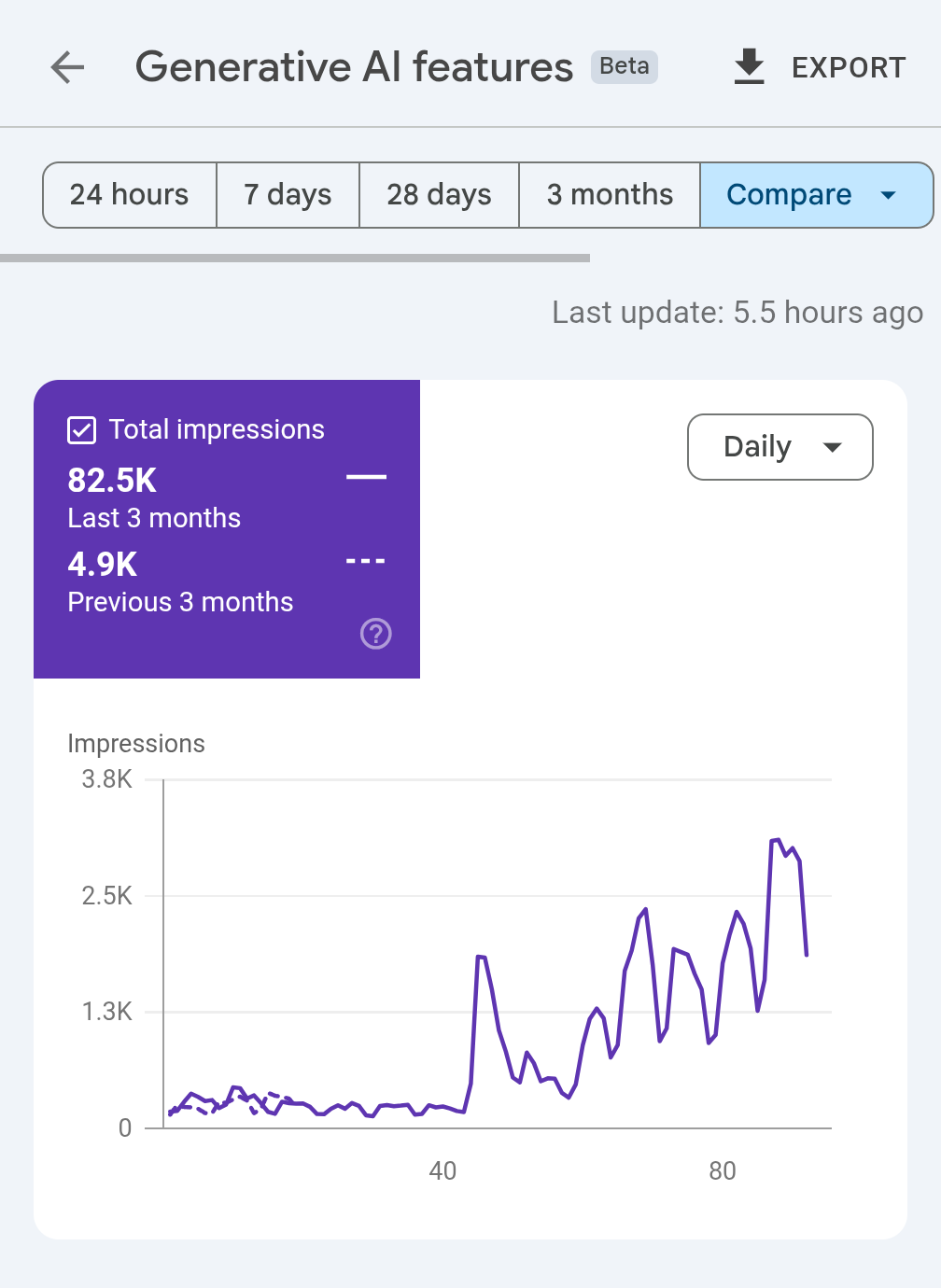
Source: Google Search Console — Generative AI features report, this law firm's own property.
What's Included in a Toronto Law Firm AI Website
The specific scope of an engagement depends on your firm's practice areas and current website, but every Toronto build draws from the same core set of capabilities. If you're wondering what that means in practice, how many pages a law firm website actually needs is a good place to start.
Why Toronto Law Firms Need a Stronger Digital Presence
Toronto and the wider GTA make up one of the most competitive legal markets in North America. Ontario has one of the highest lawyer-to-population ratios in Canada, and a large share of that competition is concentrated in and around the city — which means a website that simply lists practice areas and a phone number gives a prospective client little real reason to choose your firm over the dozens of others they're also considering.
Differentiation in a market this dense has to happen on several fronts at once: by practice area, by the specific client problem a page addresses, by location and service area, by demonstrated experience, and by genuinely helpful resources a visitor can use before ever picking up the phone. Structured data plays a real role here too — see what schema markup is and why a Toronto law firm's website needs it.
How a Toronto Engagement Works
Every Toronto engagement follows the same clear process. If you're trying to plan around a timeline, how long it actually takes to build an AI-optimized law firm website walks through each stage below in more detail.
Traditional Website vs. Lexscale.ai AI Website
Why Lexscale.ai
Lexscale.ai works specifically with law firms across North America — not as one vertical among many, but as the core focus. That specialization means every recommendation is filtered through what actually matters for a legal services page: how practice-area content needs to be structured, how lawyer credibility is established, what client-intent searches actually look like, how internal linking builds topical authority, what schema a law firm site needs (see our full guide to schema markup for lawyers), and how AI-search visibility works specifically for legal content.
A generalist agency can build a website. Building one engineered for how AI systems and search engines evaluate a law firm specifically is a narrower, different discipline — the same distinction we walk through in AI website vs. a normal WordPress site — and it's what this part of our work is built around.
Related Reading: AI Website Design Insights
Toronto Website Insights: Questions Answered Directly
From My Experience — James Harmiden
Every few weeks I get on a call with a Toronto firm that's been paying the same web agency for years — sometimes a lot of money — for a WordPress site running twenty plugins nobody remembers installing, a theme that hasn't been touched since 2019, and a load time that would make an AI crawler give up before it finished reading the homepage. Nobody told them that was the problem. They just knew leads had slowed down and assumed it was the market.
I've rebuilt enough of these sites to know the pattern by now. The firm wasn't losing to a bigger competitor — it was losing to its own website's dead weight. Strip out the plugin bloat, build something fast and properly structured instead of dressed up with a theme, and the difference isn't subtle — we cover exactly how that move works, rankings intact, in how to move a law firm website off WordPress without losing your Google rankings. It's usually the fastest, cheapest win available to a firm that's been quietly bleeding traffic for years without knowing why.
That's the shift I keep pushing Toronto firms toward: stop treating your website as a one-time expense you set and forget, and start treating it as the piece of infrastructure that decides whether AI systems and Google both trust you enough to send someone your way.
— James Harmiden, Founder & CEO, Lexscale.ai