Real results from a Toronto law firm engagement, built on the same system we bring to Ottawa — read the full case study →
Why Ottawa Law Firms Need More Than a Template Website
Walk through the websites of twenty different Ottawa law firms and a pattern emerges quickly: most were built from the same handful of generic legal industry templates, with a logo swapped in and a city name pasted into the footer. That approach was defensible a decade ago, when the bar for a "good enough" law firm website was simply looking professional. It is no longer defensible in a market where AI systems are actively reading, parsing, and deciding whether to cite your site as an authoritative answer to a federal employee's question about a workforce reduction, or a Kanata tech worker's question about a non-compete clause. See why law firms need AI-optimized websites in 2026 for the fuller picture of why this shift matters.
A template website built for generic professional services rarely has the technical structure — clean semantic HTML, proper schema markup, fast load times, clear entity signals, and genuine bilingual support — that AI crawlers need to understand who you are, what you practice, and why you should be trusted. This page covers what an AI-optimized website actually requires in the Ottawa market, and how it connects to AI SEO for Ottawa law firms, the visibility strategy that determines whether anyone ever finds that website in the first place.
Template Website vs. AI-Optimized Website
A slow, English-only website doesn't just lose visitors in a bilingual capital — it tells AI systems your firm isn't built to serve this market. In 2026, how fast a page loads and how cleanly it's structured say as much about a firm as the words on it.
James Harmiden · Founder & CEO, Lexscale.ai
What Makes a Website "AI-Optimized" in 2026
Being "AI-optimized" isn't a design aesthetic — it's a legibility requirement. Both the crawler indexing your site for ChatGPT's next answer and the human who just landed on it from a Google search need to figure out, within seconds, who you are, what you practice, and why they should trust you. In practice that starts with headings that state their subject plainly — "Federal Employment Lawyer in Ottawa" beats a clever tagline every time — and continues with structured data that spells out your firm's name, practice areas, service area, and credentials in a format a machine can read without guessing.
It also demands actual depth on the topics that bring Ottawa clients to a lawyer in the first place. A stock-photo employment page with three sentences of boilerplate gives an AI system nothing to confidently cite when someone asks what happens to their pension after a federal workforce reduction. The pages that get cited are the ones that go far enough into the actual mechanics — federal grievance timelines, Ontario Superior Court process, what a Barrhaven new-build closing involves — that a reader and a language model both recognize real expertise rather than filler.
Why a Slow Site Undoes Everything Else You Build
None of the content or schema work on this page matters if the site carrying it loads slowly. Google counts load speed, interactivity, and visual stability directly in its rankings, and AI crawlers behave the same way — a site that takes its time to load gets crawled less often and less completely, which means less of your content ever makes it into a model's understanding of your firm. Get the content right and skip the speed work, and you've built a strong case nobody sees.
Most older Ottawa law firm sites are running on content management systems accumulated over a decade — plugins nobody remembers installing, unoptimized images, scripts that block rendering until they finish loading. Rebuilding one from scratch, on lean code built for exactly the pages a firm needs and nothing else, routinely takes a three-second load down to under a second — and that gap shows up in both how often AI systems crawl the site and how many visitors stick around long enough to book a consultation.
Building for a Bilingual Capital
Ottawa has been officially bilingual by municipal by-law since 2001, and roughly one in seven residents speaks French as their primary home language, with a notably higher concentration in the city's east end. A law firm website built only in English is invisible to a meaningful share of the National Capital Region's prospective clients — and machine-translating an English site as an afterthought creates exactly the kind of imprecise legal terminology that undermines trust in a professional services context.
Genuine bilingual support means dedicated French-language pages with their own URLs, proper hreflang tags so search engines serve the right version to the right searcher, and content reviewed by a fluent speaker familiar with legal terminology — not a browser translation widget bolted onto an English site. For firms actively serving French-speaking clients, this is one of the highest-leverage, most consistently skipped opportunities in the Ottawa market.
Giving AI Systems a Structure They Can Actually Follow
A crawler doesn't experience your site the way a person does — it reads structure, and structure is where most law firm sites fall apart. That starts with a heading hierarchy that actually means something: one H1 naming the page's core topic, H2s for genuine sections, H3s for what's inside them, never chosen for how large the text looks. It continues with internal linking that maps out real relationships between ideas — a federal employment page pointing to a workforce-reduction FAQ, which points to a pension-implications guide — so a crawler can trace a connected body of expertise instead of finding disconnected pages that happen to share a domain. How many pages an Ottawa law firm website should have covers what that structure actually needs to include.
It also means your firm's core facts can't live only inside a JavaScript widget that a crawler might not fully execute. Your name, practice areas, service area, and contact information — in French and English wherever that applies — need to sit in the page's actual HTML, readable without running a script first.
Schema Markup for Ottawa Law Firm Websites
Think of schema markup as translation: it takes what your website says in prose and restates it as structured facts a machine can parse without inference. For an Ottawa firm that typically means LegalService schema describing the firm itself, Attorney or Person schema for each lawyer with credentials and sameAs links back to their Law Society of Ontario profile and LinkedIn, FAQPage schema mirroring any visible FAQ content, and BreadcrumbList schema laying out how the site is organized.
It's also the piece most Ottawa firm sites skip entirely, which makes it one of the cheapest wins available — see what schema markup is and why an Ottawa law firm's website needs it for the full breakdown. A well-marked-up site hands an AI system the exact structured facts it needs to build confidence in your firm as an entity, and that confidence is a large part of what determines whether you get cited. Schema work sits right at the seam between this page and AI SEO for Ottawa law firms, since the same markup that helps a crawler understand your site is also what helps it decide your site is worth citing.
Conversion Design: Turning Ottawa Visitors Into Consultations
None of the crawling or citation work matters if a visitor who actually reaches your site can't figure out how to book a consultation. That means a contact path visible on every single page, not tucked three menu levels deep. It means putting the reassurance a nervous visitor needs — credentials, results described the way the Law Society of Ontario's advertising rules allow, a plain account of what happens after they reach out — exactly where they'll see it, not buried below the fold.
It also means designing for the reality that many Ottawa legal problems arrive with genuine urgency — a federal employee who just received a workforce adjustment letter, a family served with a support variation notice. A visitor in that position is not in a browsing mood — they need to quickly confirm this firm understands their situation and can help, and then take action. Long forms, vague next steps, and generic corporate copy all cost conversions right at the moment your firm most needs to make saying yes effortless.
Mobile-First Design for a Growing Suburban Region
A significant majority of legal searches across the National Capital Region now happen on mobile, and Ottawa's population growth over the past decade has concentrated heavily in suburban communities — Kanata, Barrhaven, Orleans, and Nepean captured roughly 80% of the region's growth between 2016 and 2021. Those are commuter communities, where a prospective client is frequently searching from a phone during a commute on the Queensway, not sitting at a desktop downtown.
In practice that means the phone number and the primary call-to-action are usable with one thumb, without zooming in or hunting through a collapsed menu — and the contact form is short enough to finish before the bus reaches the next stop. For a firm whose client base is genuinely commuting, not browsing from a desk, this isn't a nice-to-have design choice; it's the difference between converting the traffic your AI SEO work earns and losing it at the last step.
Building Law Society of Ontario Compliance Into the Site Itself
Case results, testimonials, any headline that could read as a guaranteed outcome, disclosures on an AI chatbot — every one of these needs to clear the Law Society of Ontario's advertising and marketing rules before it goes live, in whichever language it's published in. Most web design agencies working across a dozen industries have no reason to know these rules exist, let alone build a review step for them into a standard project.
This is the same discipline covered from the visibility side on the Ottawa AI growth hub — compliance on the website and compliance in SEO content are really one review process applied twice.
Migrating an Existing Ottawa Firm Website Without Losing Ground
Most Ottawa firms weighing a rebuild aren't starting from zero — there's an existing site with years of Google rankings and backlinks behind it, sometimes including French-language pages that took real effort to produce. Handled carelessly, a migration can throw that away in a weekend. Handled properly, it starts with a full inventory of every existing URL, a mapping of each one to where it lives on the new site, redirects tested before anything goes live, and close monitoring of Google Search Console for weeks afterward — the full process is covered in how to move an Ottawa law firm website off WordPress without losing your Google rankings. If you're planning around a timeline instead, how long an AI-optimized website build actually takes in Ottawa walks through the stages below in more detail.
This matters just as much for French-language content as English — a firm's French pages often carry disproportionate value precisely because so few competitors have built genuine bilingual content, and losing that ground in a migration would be a real, avoidable setback.
Case Study · Toronto Law Firm
From a 140-Page WordPress Site to a 570-Page AI Legal Website
This is a Toronto engagement, not an Ottawa one — we don't yet have a published National Capital Region case study — but it's the same system we'd bring to an Ottawa firm. Lexscale.ai transformed this law firm's website from an approximately 140-page WordPress website into an approximately 570-page AI-ready legal website, adding practice-area depth, supporting legal insights, service-area content, legal calculators, interactive guided wizards, structured data, and strategic internal linking, on faster, purpose-built infrastructure.
The result: organic website traffic tripled within 90 days. Results vary by firm, market, and existing authority — but an Ottawa build follows the identical process, adapted for genuine bilingual EN/FR support and Law Society of Ontario compliance.
Since then, this same law firm's visibility in Google AI Overviews has grown from 4.9K to 82.5K impressions in 3 months — verified directly in Google Search Console.
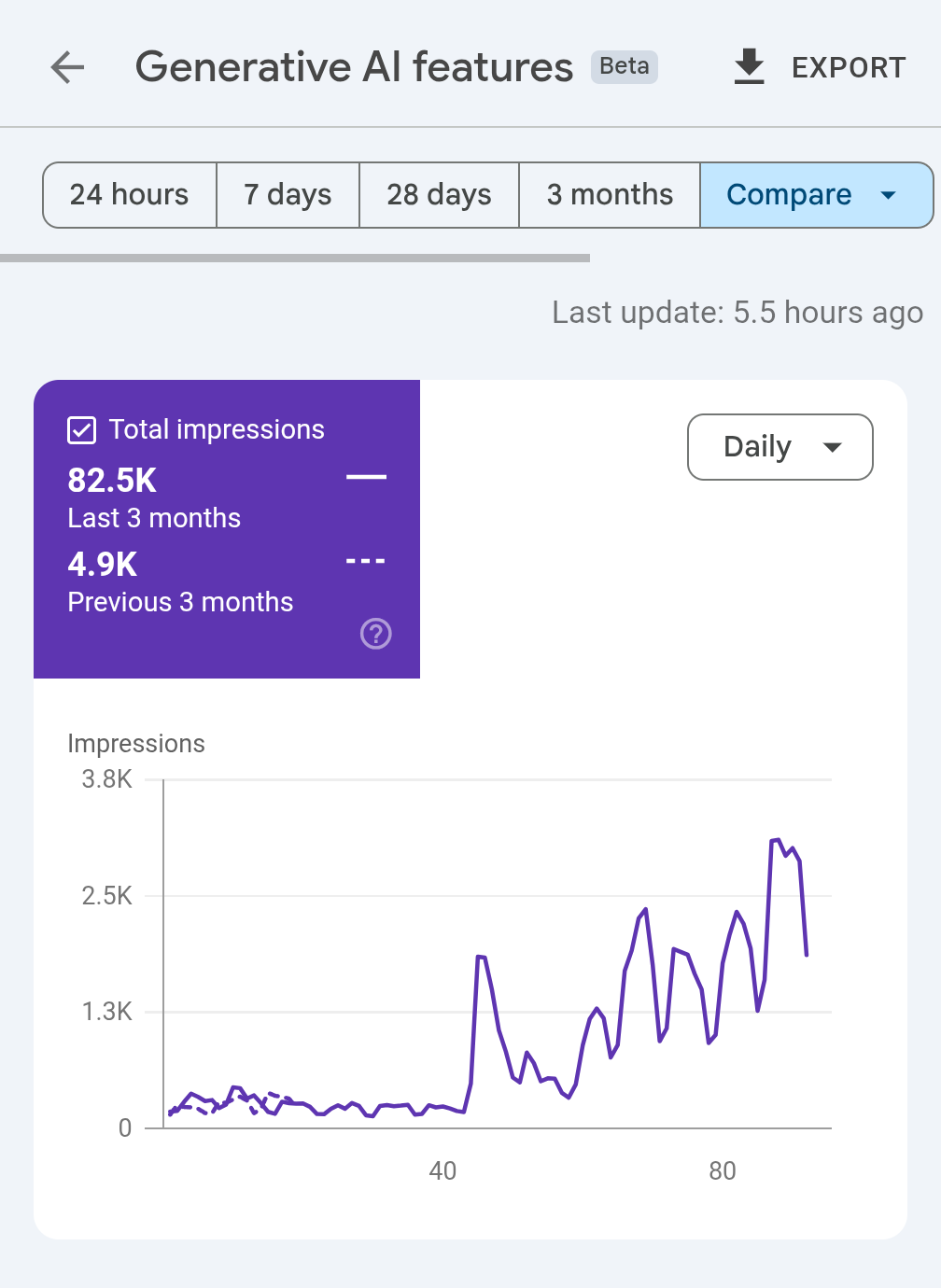
Source: Google Search Console — Generative AI features report, this law firm's own property.
Common Website Mistakes Ottawa Firms Make
The most common mistake is a website that never mentions the federal public service, employment adjustment, or pension implications at all — despite this being one of the single largest, most consistent sources of legal demand in the entire National Capital Region. A generic "we handle employment law" page with no specific reference to federal grievance processes or workforce reduction rights is invisible to exactly the client base most likely to be searching right now, and it's the same pattern covered in is my current Ottawa law firm website losing me clients.
The second common mistake is treating French-language content as optional in an officially bilingual capital. A firm that ignores this isn't just missing a compliance nicety — it's ignoring a meaningful, currently underserved share of the market that most competitors have also ignored, which is precisely what makes it a real opportunity rather than a cost center.
The third mistake is designing for a downtown, walk-in client base that increasingly doesn't reflect where Ottawa's growth actually is. With Kanata, Barrhaven, Orleans, and Nepean absorbing most of the region's population growth over the past decade, a website that isn't genuinely mobile-first and fast on a phone is failing the commuter client base that's actually driving demand.
What Working With Lexscale.ai Looks Like
The process starts with a free strategy call focused on your current site, if you have one — where it's losing visitors, where it's invisible to AI crawlers, and what a realistic build timeline looks like given your practice areas and bilingual needs. From there our team handles the build directly: content, schema, French-language pages where they make sense, and a launch sequence built to protect whatever search equity your current site already has.
Ottawa is one focused piece of a broader practice built entirely around law firms across the U.S. and Canada, and the same website methodology we run everywhere else gets applied here with the federal employment base, the bilingual client population, and Law Society of Ontario compliance treated as requirements from day one, not an afterthought.
Related Reading: AI Website Design Insights
Ottawa Insights: Questions Answered Directly
From My Experience — James Harmiden
The Ottawa firms I audit tend to have a specific problem I don't see as often in other markets: a website that looks fine to a general audience but falls apart the moment a genuinely sophisticated visitor shows up. And Ottawa has a lot of those — federal policy lawyers, a public service workforce that reads contracts for a living, and a Kanata North tech sector full of people who can tell in about four seconds whether a site was built properly or just skinned on top of a WordPress theme.
I've rebuilt enough of these sites to see the pattern immediately: years of plugins nobody remembers adding, a load time that embarrasses the firm before a visitor even reads a word, and zero structured data telling an AI system anything meaningful about the firm's bilingual capacity or federal-adjacent practice areas. None of that is subtle to the audience Ottawa actually has.
What I build instead is infrastructure that holds up to that scrutiny — fast, properly marked up, and honest about what the firm actually does — because in a market this well-educated, a website that looks slightly off costs a firm credibility before a single word of the copy gets read. That's a faster, better result than most firms were getting from what they were already paying an agency for, and it's the only way to actually compete here.
— James Harmiden, Founder & CEO, Lexscale.ai