Real results from a law firm engagement, built on the same system we bring to Miami — read the full case study →
A Crowded, International Market Notices a Weak Website Fast
With more than 115,000 Florida Bar members statewide and one of the state's largest concentrations of them practicing right here in Miami-Dade, a generic, slow, or dated law firm website doesn't just underperform quietly — it gets outrun immediately by the dozens of other firms fighting for the same search terms. This is one of the most saturated legal markets in the country, and a website that reads like a template built for any small business gives a visitor no reason to pick this firm over the next tab they'll open. See why law firms need AI-optimized websites in 2026 for the fuller picture of why that gap matters.
This page covers what an AI-optimized site actually requires in Miami specifically, and how it connects to AI SEO for Miami law firms — the part of the equation that determines whether anyone finds the site to begin with. See the full picture, including how the two connect, on the Miami growth hub.
Template Website vs. AI-Optimized Website
A firm competing against more than a hundred thousand other Florida-licensed lawyers doesn't get a second impression. The site either loads instantly and answers the question, or the visitor is already on the next tab.
James Harmiden · Founder & CEO, Lexscale.ai
What "AI-Optimized" Actually Means for a Miami Firm
Two different readers hit a Miami law firm's website in the same instant, and both need the same thing delivered fast: an AI crawler trying to work out who you are, what you actually practice, and whether you're worth citing — and a person who's often already stressed about whatever brought them here. A vague headline serves neither one. A page that states plainly what it covers, backed by structured data that spells out your firm's name, practice areas, and service area instead of leaving a machine to guess, serves both at once. This is exactly the kind of foundational work that makes the AI SEO for Miami law firms strategy actually land once it's built on top.
Depth matters as much as clarity here. The questions actually bringing someone to a Miami lawyer right now are specific: a condo board wondering whether their building needs a milestone inspection under SB 4-D, a family that needs a will updated after buying a second home in Florida, a Spanish-speaking business owner trying to understand a commercial lease. A thin paragraph under a generic "Real Estate Law" heading answers none of that — and it convinces neither the AI system deciding whether to cite you nor the person deciding whether to pick up the phone.
Building for a Bilingual, International Client Base
Miami operates as the country's primary gateway to Latin America, and that shows up directly in who's typing a search query into a phone at any given moment — a real, meaningful share of prospective clients here are more comfortable researching and communicating in Spanish. A site that only exists in English is quietly telling a large slice of the local market to look elsewhere, and it's leaving a huge amount of achievable AI-search visibility on the table, since AI systems answer in whatever language the question was asked in.
That doesn't mean a thin, machine-translated afterthought bolted onto an English site. It means genuinely planned bilingual content structure — the kind covered in more depth in our guide to multilingual law firm websites — built into the site's architecture from the start, not patched in after the fact. Combined with the visibility work on AI SEO for Miami law firms, it's how a firm actually reaches the full breadth of this market instead of half of it.
Why Speed and Structure Matter More Here, Not Less
A slow site is a real cost everywhere, but it's a sharper one in a market with this much competition sitting one search away — see the Miami growth hub for how that competitive density plays out across the whole market, not just on-page. Someone comparing Miami firms — an out-of-state condo owner who just got a special-assessment notice, a business owner relocating a subsidiary from Latin America — is often comparing two or three firms open in adjacent browser tabs. Every extra second a page takes to load is a real, measurable chance that visitor closes the tab and picks whichever competitor answered faster.
Schema markup solves a related but different problem: it tells an AI crawler, in a format it can parse instantly, exactly what your firm is, what it practices, and where it serves clients — without requiring the system to infer any of that from loosely structured prose. A site missing that structured layer is legible to a person and largely illegible to the systems increasingly deciding who gets recommended.
A Website Built Around Florida's Filing Regime, Not Around It
Rule 4-7.19 of the Rules Regulating The Florida Bar requires most attorney advertisements to be filed with the Bar at least 20 days before they run, evaluated against Rules 4-7.11 through 4-7.15, with a response due within 15 days of a complete filing and a mandatory fee — $150 on time, $250 if filed late. That's a genuinely different operating environment from every other city or province Lexscale.ai has built a cluster for, and it changes how a Miami site actually gets built: copy gets checked against those specific content rules before launch, not rewritten in a panic after a complaint. More on the full regulatory picture is on the Miami growth hub.
Practically, that means testimonials, guarantees, and comparative claims — all restricted under the underlying rules Rule 4-7.19 evaluates against — are handled with real care on a Miami site, not treated as generic marketing filler the way a template built for another state might treat them.
What This Looks Like Built, Step by Step
Why Not Just Use a Generic Website Builder or Local Agency
A generic website builder or a general-purpose local agency can produce something that looks fine to a person. Neither one is thinking about Rule 4-7.19 filing risk, LegalService schema, or how an AI crawler parses your practice-area pages — because none of that is relevant to the restaurants and retail clients that make up most of their book of business.
Lexscale.ai only builds for law firms, across the US and Canada, which means every recommendation on a Miami site — down to how a chatbot script describes a service — gets checked against what Florida actually allows a lawyer to say. That review runs alongside the visibility work covered on AI SEO for Miami law firms, and both connect back to the full picture on the Miami growth hub.
Case Study · Law Firm Engagement
From a 140-Page WordPress Site to a 570-Page AI Legal Website
Lexscale.ai transformed this law firm's website from an approximately 140-page WordPress website into an approximately 570-page AI-ready legal website — adding practice-area depth, supporting legal insights, service-area content, legal calculators, interactive guided wizards, structured data, and strategic internal linking, on faster, purpose-built infrastructure.
The result: organic website traffic tripled within 90 days. Results vary by firm, market, and existing authority — but a Miami build follows the identical process, adapted specifically for Rule 4-7.19 advertising compliance and the market's bilingual client base.
Since then, this same law firm's visibility in Google AI Overviews has grown from 4.9K to 82.5K impressions in 3 months — verified directly in Google Search Console.
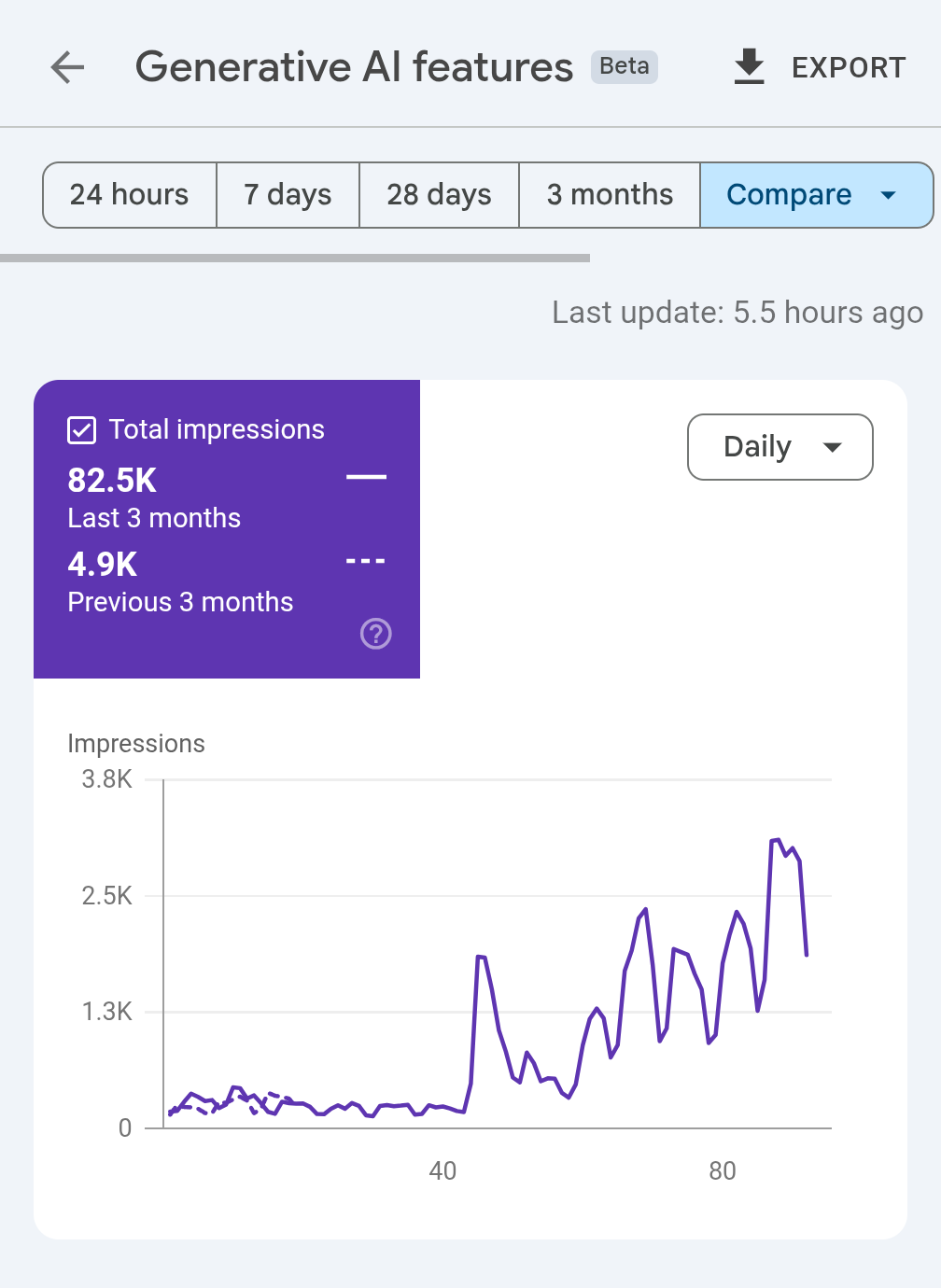
Source: Google Search Console — Generative AI features report, this law firm's own property.
Real Estate and Condo Content Deserves Its Own Attention Here
Given how much of Miami's current legal demand traces back to the post-Surfside inspection and reserve-funding requirements, a Miami firm's website should treat real estate and condo association content as a priority, not an afterthought. That means actual pages addressing SB 4-D milestone inspections, the 2025 HB 913 adjustments, and what a special assessment means for a unit owner — not a single generic "Real Estate Law" page copied from a template built for a state with no equivalent rule. For a deeper look at how a real estate-focused site should actually be structured to convert, see our guide on real estate law websites built to convert buyers and sellers and real estate attorney SEO for property law.
Estate planning content deserves similar attention for a different reason: Miami's steady snowbird and retiree population creates ongoing demand for wills, trusts, and probate guidance written for someone who owns property in more than one state. Our guide on estate planning websites built for trust and conversion covers what that content should actually look like.
From My Experience — James Harmiden
I've reviewed a lot of law firm websites over the years, and Miami sites have a specific failure mode I don't see nearly as often anywhere else: they're built as if the only person who's ever going to read them is a lifelong Miami resident who speaks English at home and has lived in one condo building for twenty years without incident. That description fits maybe a third of the actual market. The rest is international clients, recent transplants, Spanish-speaking families, and — right now, more than almost anything else — condo owners who just found out their building needs an inspection they've never had to think about before.
The Rule 4-7.19 filing requirement changes how I think about every sentence that goes on a Miami site, not just the obviously promotional ones. Twenty days' notice and a $150 fee before an ad can even run means there's no room for "we'll fix the wording later if someone complains." It has to be right on the way out the door, which is a genuinely different discipline than what most website builds require.
What I keep coming back to is that the firms building real, specific content about milestone inspections and special assessments right now — while a lot of their competitors are still running a generic "Real Estate Services" page from three years ago — are going to be the names AI systems keep citing on this topic for years. That window doesn't stay open. Every month more firms catch up to what happened after Surfside, and the ones who moved early keep the advantage.
— James Harmiden, Founder & CEO, Lexscale.ai