Real results from a law firm engagement, built on the same system we bring to Miami — read the full case study →
Why Ranking Isn't the Whole Game Anymore in Miami
Miami-Dade is home to one of the densest concentrations of Florida Bar members anywhere in the state, out of more than 115,000 statewide — which means classic Google rankings alone were never going to be enough here, and they matter even less now that a large share of searches get answered before a single organic link is clicked. A firm that only measures success by its position in a traditional results page is measuring half the picture, or less. The other half — arguably the more important half now — is whether Google AI Overviews, ChatGPT, Gemini, and Perplexity actually name your firm when someone asks a real question. The full picture of how the website and the visibility strategy fit together lives on the Miami growth hub.
How Google AI Overviews, ChatGPT, Gemini, and Perplexity Each Decide Who to Name
Google AI Overviews sits above the traditional list of organic results for a large and growing share of searches, synthesizing a direct answer from a small set of sources and naming them explicitly — a firm can hold the top organic ranking and still be skipped entirely if it isn't one of the handful of sources the Overview pulled from. ChatGPT works differently again: people ask it full, specific questions directly — "what happens if my Miami condo association can't afford the reserve funding SB 4-D requires" — and it responds with named firms and resources drawn from what it's read, no ranked list required. Gemini is embedded directly into Google Search, into Android's built-in assistant, and into Workspace, which means it reaches someone mid-task, asking a question inline, who wasn't necessarily thinking of it as "doing a search" at all. Perplexity positions itself explicitly as a citation-first answer engine, popular with people who want a direct answer and a clickable source in the same breath — for its users, it functionally replaces the results page entirely.
Each of those four systems is choosing from a much shorter list of names than an old-style results page ever offered, and Miami's sheer competitive density makes getting onto that shortlist harder here than in almost any smaller market. This page covers what actually earns a place on it. The technical foundation that makes any of this possible in the first place is covered on AI website design for Miami law firms.
Entity Clarity Is the Starting Point, Not an Afterthought
Before an AI system can cite a Miami firm for anything, it has to be confident about who the firm actually is — its name, its practice areas, its service area, consistently stated across the website, Google Business Profile, and legal directories. That consistency is what schema markup and entity SEO are built to establish, explicitly, in a format machines don't have to infer. Our guide to entity SEO for law firms and guide to building topical authority both cover this in more depth than fits on this page — and neither one replaces the site-level technical work covered on AI website design for Miami law firms, which is where that structured data actually lives. See Google Business Profile for Miami law firms for how that consistency applies specifically to the Google Business Profile listing itself.
Ranking first in Google used to be the finish line. In Miami right now, it's closer to the entry fee — the real competition is whether an AI system says your name out loud when someone actually asks.
James Harmiden · Founder & CEO, Lexscale.ai
The Post-Surfside Condo Wave Is the Single Biggest Content Opportunity Here
Senate Bill 4-D, passed after the 2021 Champlain Towers South collapse in Surfside killed 98 people, created Florida's first statewide mandatory milestone inspection and minimum reserve-funding requirements for condo associations. House Bill 913, effective July 1, 2025, adjusted some of the compliance timelines without touching the core requirements. South Florida has the highest concentration of aging condo buildings in the state and a real shortage of engineers qualified to perform the required inspections — which means condo boards, unit owners, and buyers are searching for answers on this topic at a volume that simply didn't exist five years ago, and that volume is still climbing.
A Miami firm that builds specific, accurate content around SB 4-D and HB 913 — what a milestone inspection actually requires, what happens when a building fails one, what a special assessment means for a unit owner who can't cover it — has a real shot at becoming the name AI systems return to for this entire category of question. Our guides on real estate attorney SEO for property law and AI SEO for real estate lawyers go deeper into how that kind of topical depth actually gets structured and built out.
Writing for a Bilingual, International Audience Is an SEO Decision, Not Just a Design One
Miami's role as the primary US gateway to Latin America means a real share of the searches happening in this market are in Spanish, or start in Spanish and finish in English once a person is deciding who to call. AI systems answer in whatever language a question was asked in — which means a firm with no Spanish-language content is simply invisible to an entire category of AI-generated answers, not just harder to find. Our guide on building a multilingual law firm website covers what that content structure should actually look like, and it pairs directly with the site-level build covered on AI website design for Miami law firms.
Estate Planning Demand That Doesn't Let Up
Miami's substantial snowbird and retiree population — people who split time between Florida and somewhere colder, and often own property in more than one state — keeps steady, year-round demand for estate planning content: wills, trusts, probate, and questions specific to owning property across state lines. Our guide to estate planning SEO for Google and AI search and AI SEO for estate planning lawyers cover how to build that content so it actually gets cited, not just published.
Rule 4-7.19 Shapes Content Strategy Too, Not Just Ad Copy
The Florida Bar's Rule 4-7.19 requires most attorney advertisements to be filed with the Bar at least 20 days before running, reviewed against Rules 4-7.11 through 4-7.15, with a mandatory $150 fee ($250 if late) and a response required within 15 days. That regime doesn't just govern paid ads — it shapes how a Miami firm should approach claims, comparisons, and testimonials across every piece of content on the site, since the underlying content rules the Bar evaluates against apply to advertising broadly defined. Content built without that regime in mind risks more than a missed citation; it risks a real filing problem. The full detail on how that plays into the site build lives on the Miami growth hub.
Traditional SEO vs. AI SEO for a Miami Firm
Case Study · Law Firm Engagement
From a 140-Page WordPress Site to a 570-Page AI Legal Website
Lexscale.ai transformed this law firm's website from an approximately 140-page WordPress website into an approximately 570-page AI-ready legal website — adding practice-area depth, supporting legal insights, service-area content, legal calculators, interactive guided wizards, structured data, and strategic internal linking, on faster, purpose-built infrastructure.
The result: organic website traffic tripled within 90 days. Results vary by firm, market, and existing authority — but a Miami AI SEO engagement follows the identical process, adapted specifically for Rule 4-7.19 advertising compliance and the market's bilingual client base.
Since then, this same law firm's visibility in Google AI Overviews has grown from 4.9K to 82.5K impressions in 3 months — verified directly in Google Search Console.
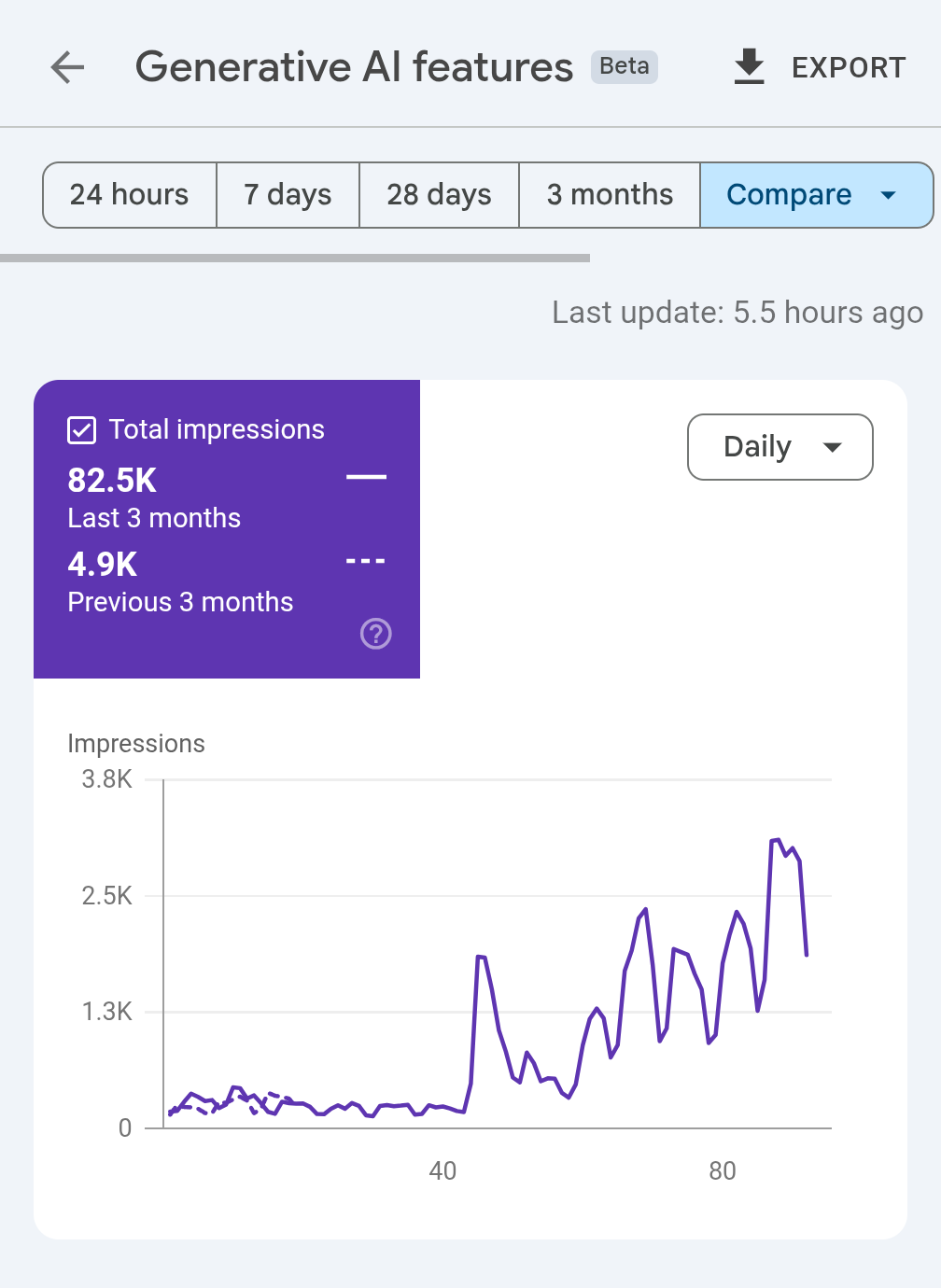
Source: Google Search Console — Generative AI features report, this law firm's own property.
Where Miami Firms Waste the Most SEO Effort
Chasing broad, national keywords a Miami firm has no realistic shot at outranking a much larger national player for, instead of the specific, local, jurisdiction-accurate questions where a well-built page can actually win a citation. AI systems reward depth and specificity over generic breadth, especially in a market this crowded.
Publishing content once and never returning to it, even as the law changes — HB 913's 2025 adjustments to SB 4-D are a perfect example of exactly the kind of update that makes previously accurate condo-law content stale within a single year. AI website design for Miami law firms covers the technical side of keeping a site current; the content strategy side is covered right here.
A third waste pattern is specific to Miami's role as the primary US gateway to Latin America: treating a Spanish-language page as a quick machine translation bolted onto the English site instead of genuinely optimized content in its own right. A real bilingual strategy means separate keyword research for Spanish-language search behavior (which doesn't map one-to-one onto English queries), proper hreflang tags so Google serves the right version to the right searcher, and Spanish-language content written by someone fluent in Florida legal terminology, not run through a translation tool and published as-is. Firms that treat their Spanish content as an afterthought are leaving an enormous, underserved slice of Miami's search volume for a competitor to pick up instead.
Website First, SEO First, or Genuinely Both
If your site is fast, well-built, and compliant already, this page is where to focus — the visibility work is what's likely missing. If it's slow or generic, start with AI website design for Miami law firms first, since no SEO strategy fixes a foundation that isn't there. Most Miami firms end up needing real investment in both within the same year. The Miami growth hub walks through how to tell which gap is bigger for your firm specifically.
From My Experience — James Harmiden
Every market we work in has its own version of "crowded," but Miami's is a different animal — more than 115,000 licensed attorneys statewide, a huge share of them concentrated in this one county, all competing for a client base that's also unusually international. I've watched firms here spend real budget trying to outrank national platforms for broad keywords they were never going to win, when the actual opportunity was sitting right in front of them: nobody had written anything good yet about what SB 4-D actually requires of a condo board.
The thing that took me longest to fully appreciate about this market is how much Rule 4-7.19 changes the calculus on content, not just on formal advertisements. Twenty days' notice, a filing fee, and a Bar response clock before something can run publicly — that's a level of formal scrutiny I haven't had to design content strategy around in any other market this site covers. It makes sloppy, rushed content genuinely expensive here in a way it just isn't everywhere else.
What I'd tell any Miami firm reading this is simple: the condo-law search wave triggered by Surfside is still climbing, most competitors still haven't written anything substantive about it, and being the AI-cited answer on that topic right now is worth more than chasing a dozen generic keywords ever will be. That's not a permanent window. It closes as soon as enough firms catch up.
— James Harmiden, Founder & CEO, Lexscale.ai