Real results from a law firm engagement, built on the same system we bring to Boston — read the full case study →
A City of Old Firms Running on Old Websites
Boston's legal market is one of the oldest and most entrenched in the country — firms that have practiced from the same Financial District or Back Bay address for decades, built entirely on reputation and referral. That history is a real asset. It's also, quietly, a liability online, because a lot of those same firms are running websites built for an era when reputation alone was enough to win a client and nobody was asking an AI system to shortlist a lawyer before ever visiting a firm's site. See why law firms need AI-optimized websites in 2026 for the fuller picture of why that shift matters.
This page covers what an AI-optimized site actually requires in a market this dense, and how it connects to AI SEO for Boston law firms — the part of the equation that determines whether anyone finds the site at all.
Template Website vs. AI-Optimized Website
A firm that has built its reputation in this city for thirty years shouldn’t lose the next client to a four-second load time on a phone.
James Harmiden · Founder & CEO, Lexscale.ai
What "AI-Optimized" Actually Means for a Boston Firm
A Boston law firm's website gets read by two very different visitors in the same few seconds — an AI crawler trying to figure out who you are and whether you're worth citing, and a person who's already stressed about whatever brought them to search in the first place. Cleverness helps with neither. What actually works is a page that states plainly what it's about, backed by structured data spelling out the firm's name, practice areas, and service area in a form a machine doesn't have to guess at.
Depth matters just as much as clarity, and Boston's client base tends to ask sharper questions than a generic search implies. A biotech employee weighing whether a non-compete actually holds up under Massachusetts law, a family evaluating a real estate closing in a Cambridge market where prices moved fast, a small business owner untangling a Superior Court dispute — a thin paragraph under a practice-area heading answers none of it, and it convinces neither the AI system deciding whether to cite you nor the person deciding whether to call.
Why a Slow Site Costs More in a Market This Crowded
A slow-loading page undercuts every other improvement made to a Boston firm's site. Google treats Core Web Vitals as a ranking factor in its own right, and AI systems crawl a slow site less often and less completely while piecing together what's actually on it — so a speed problem doesn't just cost an impatient visitor, it quietly compounds into a visibility problem too. With dozens of competing firms one search away, that compounding is what separates a firm that shows up from one that doesn't.
Walk through most of Boston's older law firm sites and the story repeats: a content management system that's accumulated a decade of plugins nobody remembers installing, sitting on top of images nobody ever bothered to compress. Rebuilding it the AI-optimized way clears all of that weight out — purpose-built code in place of a general-purpose CMS hauling around features a five-page law firm site was never going to use. Our law firm website speed and performance guide covers exactly what to fix first.
None of this happens in isolation from the visibility question, either — a firm unsure whether speed or citations are the bigger drag on its growth can walk through both at once on the Boston AI growth hub.
A Page Structure AI Systems Can Actually Follow
An AI system reads a site's structure at least as closely as its sentences — a single H1 naming the page's actual topic, H2s that mark real sections instead of getting scattered in purely for visual rhythm, and internal links that connect ideas the way an experienced colleague would point you from one question to the next: an employment page pointing to a non-compete FAQ, which points to a severance question. Get that right and a site stops reading as a stack of disconnected pages and starts reading as one coherent body of expertise an AI system can actually walk through.
It also means the essentials — firm name, practice areas, service area, phone number — need to live in the page's actual HTML, not buried somewhere inside JavaScript a crawler may or may not fully render. Betting that a crawler will execute every script correctly isn't a risk worth taking with the exact information a client needs in order to call you. Our law firm website SEO structure guide covers what that architecture should actually look like.
The structural side is only half of what earns a citation, though — the content sitting inside that structure has to hold up too, which is exactly what AI SEO for Boston law firms gets into next.
Schema Markup for a Boston Law Firm
Schema markup tells search engines and AI systems what's actually on a page in a format they don't have to interpret — no guessing required. For a Boston firm that usually means LegalService schema for the firm itself, Attorney schema for each lawyer with sameAs links pointing to their BBO record and LinkedIn, FAQPage schema that mirrors what's genuinely visible on the page, and BreadcrumbList schema laying out how the site fits together.
It's also one of the most consistently skipped pieces of a Boston firm's site, which is exactly why fixing it moves the needle so much in a market this dense — an AI system needs those structured facts to build real confidence in an entity before it'll ever cite it over one of the other seventy-six thousand attorneys in the state. See our full guide to schema markup for lawyers for the complete picture, and AI SEO for Boston law firms covers the visibility side of this same work in more depth.
Designing for a Client Base That Expects More
Harvard and MIT feed a steady pipeline of founders, researchers, and highly educated professionals into greater Boston's client base — people used to polished, fast software in their working lives who bring the same expectations to a law firm's website. A site that loads slowly or reads like a generic small-business template signals a mismatch with that audience before a visitor reads a single sentence.
It also raises the bar on substance. A non-compete dispute tied to a Kendall Square biotech role, a founder's equity question after a funding round fell through — that's a client evaluating whether a firm actually understands the stakes involved, not just whether it can file the right form. Content that engages with that specificity converts better than content that stays generic to avoid getting anything wrong.
What BBO Advertising Rules Mean for Site Copy
This is a real, practical wrinkle specific to Massachusetts: Mass. R. Prof. C. 7.1 bars any communication about a lawyer's services that's false or misleading, and the rules that follow set specific limits on solicitation and how a firm identifies its practice areas. That's a different framework, with different language and different interpretive guidance, than what a copywriter used to a Canadian law society's rules would expect to check against.
In practice, that means every headline, bio, and piece of case-result language on a Boston firm's site gets a review pass built specifically around Rule 7.1 through 7.5 — not a generic "sounds accurate to me" skim, but one checked against what the BBO actually enforces. A generalist copywriter trips over this constantly. A process built around it from the start catches it before anything ever goes live.
Mobile Isn't the Backup Experience
Most legal searches in this market now start on a phone — mid-commute on the Red Line, in a Kendall Square break room right after a rough conversation with HR, on a couch after a phone call about a family matter. A site designed for a desktop monitor and only nominally "responsive" on mobile introduces friction at exactly the moment a visitor has the least patience left for it.
Designing mobile-first means the phone number sits in plain sight and taps without hunting for it, the contact form is short enough to complete one-handed, and nothing on the page demands pinching or zooming to read. For a Boston firm, that detail decides how much of the traffic an SEO strategy earns actually converts into a booked consultation — because a large share of that traffic never opens a desktop browser at all.
Mistakes We See Most Often in This Market
The most common one is content that could have been written for any state in the country — the wrong court name, no mention of the Superior Court or the Boston Municipal Court, nothing that actually ties the firm to Massachusetts' legal landscape. AI systems are getting sharper at catching when content doesn't match the jurisdiction it claims to cover, and a mismatch like that costs a firm the citation instead of earning it.
The second is contact information that drifts out of sync between the website, the footer, and Google Business Profile — a transposed digit in a phone number, an office address nobody got around to updating after a move. Individually minor, but each one erodes the same entity trust that both Google and AI citation depend on.
The third is schema markup implemented once, years back, and never revisited as the site's content shifted around it, so it quietly stops matching what's actually on the page.
Fourth, and the one most firms underrate, is a thin attorney bio page. A genuine bio with a sameAs link to a verifiable BBO record carries more weight for citation and client trust than most firms expect a single page to hold — see our guide to attorney bio pages that convert for what a bio actually needs — especially in a market where a prospective client is often choosing among a dozen firms that all sound roughly interchangeable at first glance.
What This Actually Returns
The direct payoff: fewer visitors bouncing off a slow page, more of them actually booking a consultation because the path to contact is never in question, and a technical base that makes every SEO dollar spent afterward stretch further — because the content that dollar produces finally has a structurally sound place to live.
The less direct payoff is durability. A site built on lean, purpose-built infrastructure with genuine schema markup holds up longer than a template does, because the fundamentals underneath it — speed, clarity, structured data — stay constant even as individual AI platforms and their algorithms keep changing shape around it.
And in a market as old and reputation-driven as Boston's, a noticeably faster, clearer, more substantive site becomes a genuine, quiet reason to pick a newer or smaller firm over an entrenched name that looks fine on the surface but loads slowly and says less.
Case Study · Law Firm Engagement
From a 140-Page WordPress Site to a 570-Page AI Legal Website
Lexscale.ai transformed this law firm's website from an approximately 140-page WordPress website into an approximately 570-page AI-ready legal website — adding practice-area depth, supporting legal insights, service-area content, legal calculators, interactive guided wizards, structured data, and strategic internal linking, on faster, purpose-built infrastructure.
The result: organic website traffic tripled within 90 days. Results vary by firm, market, and existing authority — but a Boston build follows the identical process, adapted specifically for Massachusetts law and Board of Bar Overseers advertising compliance.
Since then, this same law firm's visibility in Google AI Overviews has grown from 4.9K to 82.5K impressions in 3 months — verified directly in Google Search Console.
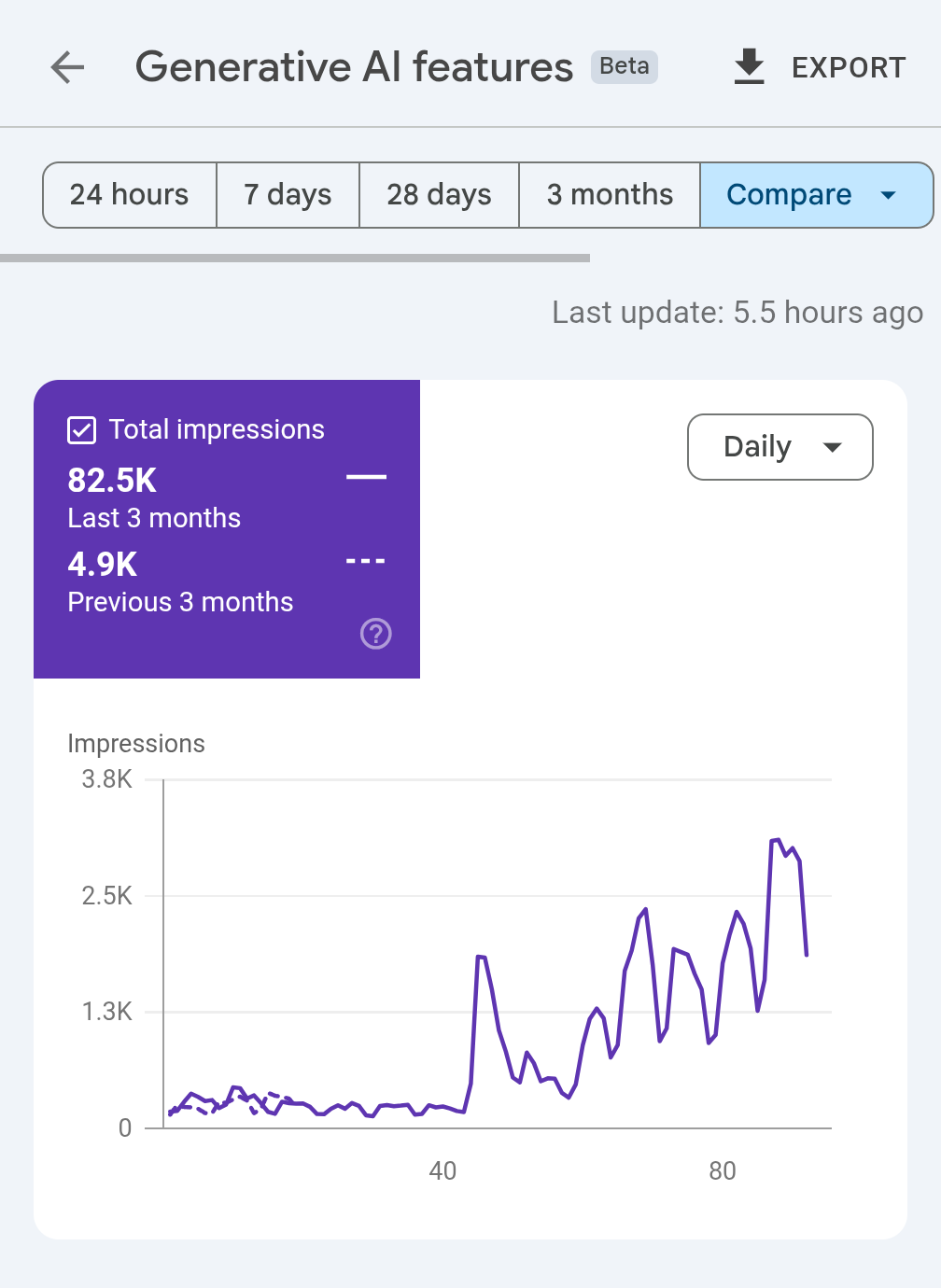
Source: Google Search Console — Generative AI features report, this law firm's own property.
Pairing Your Website With AI SEO for Boston Law Firms
A technically excellent, fast-loading, fully schema-marked site still needs a visibility strategy behind it — otherwise it's simply a well-built site nobody finds, in a state with 76,897 attorneys all competing for the same attention. That's the natural next step: AI SEO for Boston law firms, focused specifically on earning citations in Google AI Overviews, ChatGPT, Gemini, and Perplexity for what Boston and Massachusetts clients are actually asking.
Both services share the same technical spine — schema markup, entity signals, content structure — which is exactly why firms that invest in an AI-optimized website tend to see far stronger results once they pair it with a dedicated AI SEO strategy, rather than treating visibility as something to bolt on later.
What to Expect in the First 90 Days
A Boston build runs the same three phases below, timed a little tighter given how many firms here are already fielding client inquiries about their outdated site the day the engagement starts. Our law firm website conversion optimization guide covers what the finished site needs to accomplish once each phase below is complete.
Most Boston firms move straight into an ongoing AI SEO engagement after launch, since a freshly built site is exactly when a coordinated visibility push pays off fastest.
How the Build Actually Runs
It opens with an audit of what's already live and a strategy call to sort out priorities, then Lexscale.ai handles the design, the build, the schema, and the BBO-compliant copywriting directly — no outsourced pieces, no generic template dropped in and left to chance. It's the same process behind our broader AI website design work across North America, applied specifically to what Boston needs.
From that first call to a fully launched site typically takes a handful of weeks, and most firms move straight into AI SEO the moment it's live rather than treating the website as a finished project that stands on its own. If you'd rather get the wider view before committing to a website build specifically, the Boston AI growth hub is the better place to start.
Related Reading: AI Website Design Insights
From My Experience — James Harmiden
The Boston sites I get asked to look at tend to share one thing: they were built to impress a person flipping through a directory, not a machine trying to decide whether to trust the firm at all — the same gap covered in why law firms need AI-optimized websites in 2026. I get why. This is a market where reputation was built over decades, one referral at a time, and for a long time that was genuinely enough. It stopped being enough the moment a prospective client started asking ChatGPT instead of asking a neighbor.
What I keep coming back to with Boston specifically is how much smarter the client base here tends to be about what they're asking for. A biotech employee reading their non-compete before they even call a lawyer. A founder who already understands roughly what equity dilution means and wants a site that doesn't talk down to them. Building for that audience means the site has to actually say something specific — not just look clean, but demonstrate real command of what a Kendall Square employment dispute or a Suffolk County filing actually involves.
I built this page around the idea that Boston firms aren't behind because they're bad at law. They're behind because almost nobody in this market has rebuilt their site around how an AI system actually reads it. That's a genuinely fixable gap, and in a market this competitive, closing it early is worth more here than in almost any other city we work in.
— James Harmiden, Founder & CEO, Lexscale.ai