Real results from a law firm engagement, built on the same system we bring to Boston — read the full case study →
Ten Blue Links Was Never Built for a Market This Dense
Traditional SEO assumed a person scrolling through a results page and clicking whichever blue link looked most credible. That's still a real channel, but it's shrinking fast as the majority of law firms today are getting found through an entirely different mechanism: Google's AI Overview answering the question directly at the top of the page, ChatGPT naming a firm by name when someone asks who handles a specific kind of case in Boston, Gemini summarizing options inside a search a person never scrolls past, Perplexity citing sources the way a research assistant would. Each of those four systems increasingly stands between a prospective Boston client and a law firm's actual website — deciding, on the client's behalf, which handful of firms even get seen.
Chasing rank for a handful of keywords in a state with 76,897 competing attorneys is chasing an ever-smaller share of how people actually find a firm today. AI SEO is what actually gets a firm named inside those AI-generated answers instead of buried beneath them — structured data, entity signals, and content depth an AI system can verify. It runs on the same technical foundation as AI website design for Boston law firms, which is why the two are best planned as one project, not two.
Traditional SEO vs. AI SEO
Generic legal content and content that actually knows Massachusetts read identically to a person skimming fast. An AI system checking a court name or a statute against reality tells them apart instantly — and only cites one of them.
James Harmiden · Founder & CEO, Lexscale.ai
What Google AI Overviews Are Doing to Boston Legal Searches
Google's AI Overview now sits above the results a person would otherwise scroll down to reach for a huge share of informational legal questions — what actually counts as wrongful termination under Massachusetts law, whether a non-compete signed on the way into a Kendall Square job holds up, what the Boston Municipal Court handles versus what belongs in Superior Court. A handful of sources get named directly underneath that summary, and landing on that list puts a firm in front of a prospective client before a single scroll happens.
Earning that placement takes content that answers the actual question head-on and demonstrates genuine E-E-A-T — experience, expertise, authoritativeness, trustworthiness — none of which a thin page can fake no matter how tightly it's aimed at a keyword. Get a Massachusetts-specific detail wrong — the wrong court, the wrong statute — and the content performs worse than if it had just stayed vague.
Earning a Citation in ChatGPT, Gemini, and Perplexity
ChatGPT, Gemini, and Perplexity each work differently under the hood, but they converge on the same behavior: naming the source each has concluded is relevant and trustworthy enough to lean on. For a Boston firm, that means content specific and well-structured enough for these systems to attribute the answer to your firm by name, rather than lumping you in as one of dozens of sites that mentioned the topic somewhere in a state with 76,897 attorneys all publishing something similar.
Attorney bios with real, verifiable BBO credentials, FAQ content matching how people actually phrase a question, and practice-area pages with genuine Massachusetts statute and court detail — not paraphrased boilerplate — all move the needle on whether that happens.
None of that content lives in a vacuum, either — it needs a fast, properly structured site underneath it, which is the whole subject of AI website design for Boston law firms.
Building an Entity AI Systems Can Actually Verify
Entity SEO means giving a firm and its lawyers a digital identity an AI system can independently confirm, rather than one it just has to take the site's word for — the specifics of what that requires on the site itself are covered on the Boston AI growth hub and on AI website design for Boston law firms.
That kind of verification is what actually builds an AI system's confidence — a firm running a leaner site with rock-solid, consistent entity signals routinely outperforms a firm with a much bigger site and sloppy ones. That gap widens in Boston specifically, where a client sorting through dozens of similarly credentialed firms needs some real basis for telling them apart, and inconsistent or unverifiable information is precisely what makes an AI system hesitate before citing a source.
It's not a one-time task, either. With 76,897 attorneys statewide already competing for attention, a firm that lets its website, schema, GBP listing, and directory entries drift out of sync after every new hire or office change is handing that inconsistency straight to competitors who keep theirs current.
Content That Actually Matches Massachusetts' Legal Landscape
Generic American legal content doesn't compete here, because it isn't actually about anything specific. A real content strategy for a Boston firm builds around what this market's client base is genuinely asking: non-compete enforceability questions tied to Kendall Square's biotech boom-and-bust cycle, equity and severance questions following a layoff at a major life-sciences employer, and real estate and business disputes running through the Superior Court or Boston Municipal Court rather than a generic "the courts."
That content also has to hold up under an actual read, not just occupy space beneath a heading. A realistic timeline, an honest caveat about what varies case to case, a specific, correct reference to the Trial Court, the Superior Court, or Mass. R. Prof. C. 7.1 instead of a vague gesture at "the rules" — that's what actually persuades a person and an AI system alike.
Prioritizing matters more than covering everything at once. A firm doing employment, real estate, and family law is usually better off building genuine depth on the one or two areas that actually drive its business first, rather than spreading thin across ten in a market where dozens of other firms are already publishing on all ten.
The Kendall Square employment angle specifically is close to uncontested right now — almost no Boston firm has dedicated content explaining what a biotech employee actually needs to know about a non-compete or a severance package, which makes it one of the rare topics where a firm can build real authority fast rather than fighting an entrenched field of generalist competitors.
A Court System Worth Getting Exactly Right
The Massachusetts Trial Court splits its work three distinct ways — the Superior Court for major civil litigation, the Boston Municipal Court for matters specific to the city, and the District Court for small claims. Content that gets this right, plainly and specifically, signals real local knowledge in a way generic "the courts will decide" language never does, and it's exactly the kind of detail an AI system is built to check before deciding whether to cite a source. The Boston AI growth hub covers more of what makes this legal infrastructure genuinely different from other states.
Schema and Structured Data, the Non-Negotiables
A Boston firm's markup checklist: LegalService or ProfessionalService for the practice itself, Attorney entries for every lawyer, FAQPage tags that match the visible questions exactly, BreadcrumbList across the site, and Article schema with genuine dates on published insight content.
This isn't separable from how the site itself is structured — AI website design for Boston law firms covers that other half in detail.
Google Business Profile in a Neighborhood-by-Neighborhood City
Boston clients tend to search by neighborhood before they search by city — Back Bay, Beacon Hill, the Seaport — which makes a GBP listing's category accuracy and service-area detail carry more weight here than in a market where people just search the citywide name. A stack of reviews from three years ago doesn't help; a steady, current trickle does.
Most Boston firms have never checked whether their GBP categories and their website's schema actually line up, and that mismatch is precisely the kind of gap that costs a firm the entity confidence an AI system needs before it'll cite it.
Backlinks in a City Built on Institutions
A link from a genuinely respected source still moves the needle — in traditional rankings and in how confidently an AI system decides to cite a firm. In Boston that mainly means getting quoted in local business or biotech-trade coverage, weighing in publicly on Kendall Square's layoff and funding cycles, and building real referral relationships with in-house counsel at the life-sciences companies clustered a few subway stops away.
A single genuine mention in a Boston business publication outweighs a stack of directory listings every time. Generic directory backlinks used to be nearly the whole local SEO playbook; today's algorithms see through most of them and discount them accordingly.
Boston's concentration of major research universities and hospital systems also opens a specific, underused angle: relationships built through alumni networks, startup accelerators, and industry associations tied to Harvard and MIT can produce genuine referral links around employment and corporate questions that a smaller American market simply doesn't have the density to support.
What BBO Compliance Means for AI-Assisted Content
Any Boston firm using AI tools to help draft content needs a review step between generation and publication — and Massachusetts' rules add a wrinkle most generic AI writing tools won't catch on their own: Mass. R. Prof. C. 7.1's specific bar on false or misleading claims about a lawyer's services. A generic AI content tool trained on marketing copy from other industries will default to exactly the kind of overstated language that rule was written to prevent, which means every AI-assisted draft needs a pass that specifically checks for it, not just a general accuracy check.
In practice that means every piece of AI-assisted content gets checked against BBO advertising standards before it goes live, the same way a firm would review a junior associate's first draft.
What's Actually Worth Measuring
AI SEO doesn't fit the old measurement playbook, since a citation tucked inside an AI-generated answer rarely leaves behind the clean, clickable link that traditional rank-tracking was designed around. What genuinely tells you something instead: manually checking, query by query, whether ChatGPT, Gemini, and Perplexity name the firm for target searches; watching priority searches for AI Overview appearances; tracking branded and direct traffic as a downstream signal; and paying attention any time a new client mentions finding you through an AI tool rather than a plain Google search.
Check this monthly, not quarterly — both AI-driven and traditional visibility bounce around week to week even when the real trend is heading in the right direction, and any Boston firm vetting an AI SEO partner should ask, specifically, how they're going to track and report citations before signing anything.
Case Study · Law Firm Engagement
From a 140-Page WordPress Site to a 570-Page AI Legal Website
Lexscale.ai transformed this law firm's website from an approximately 140-page WordPress website into an approximately 570-page AI-ready legal website — adding practice-area depth, supporting legal insights, service-area content, legal calculators, interactive guided wizards, structured data, and strategic internal linking, on faster, purpose-built infrastructure.
The result: organic website traffic tripled within 90 days. Results vary by firm, market, and existing authority — but a Boston AI SEO engagement follows the identical process, adapted specifically for Massachusetts law and Board of Bar Overseers advertising compliance.
Since then, this same law firm's visibility in Google AI Overviews has grown from 4.9K to 82.5K impressions in 3 months — verified directly in Google Search Console.
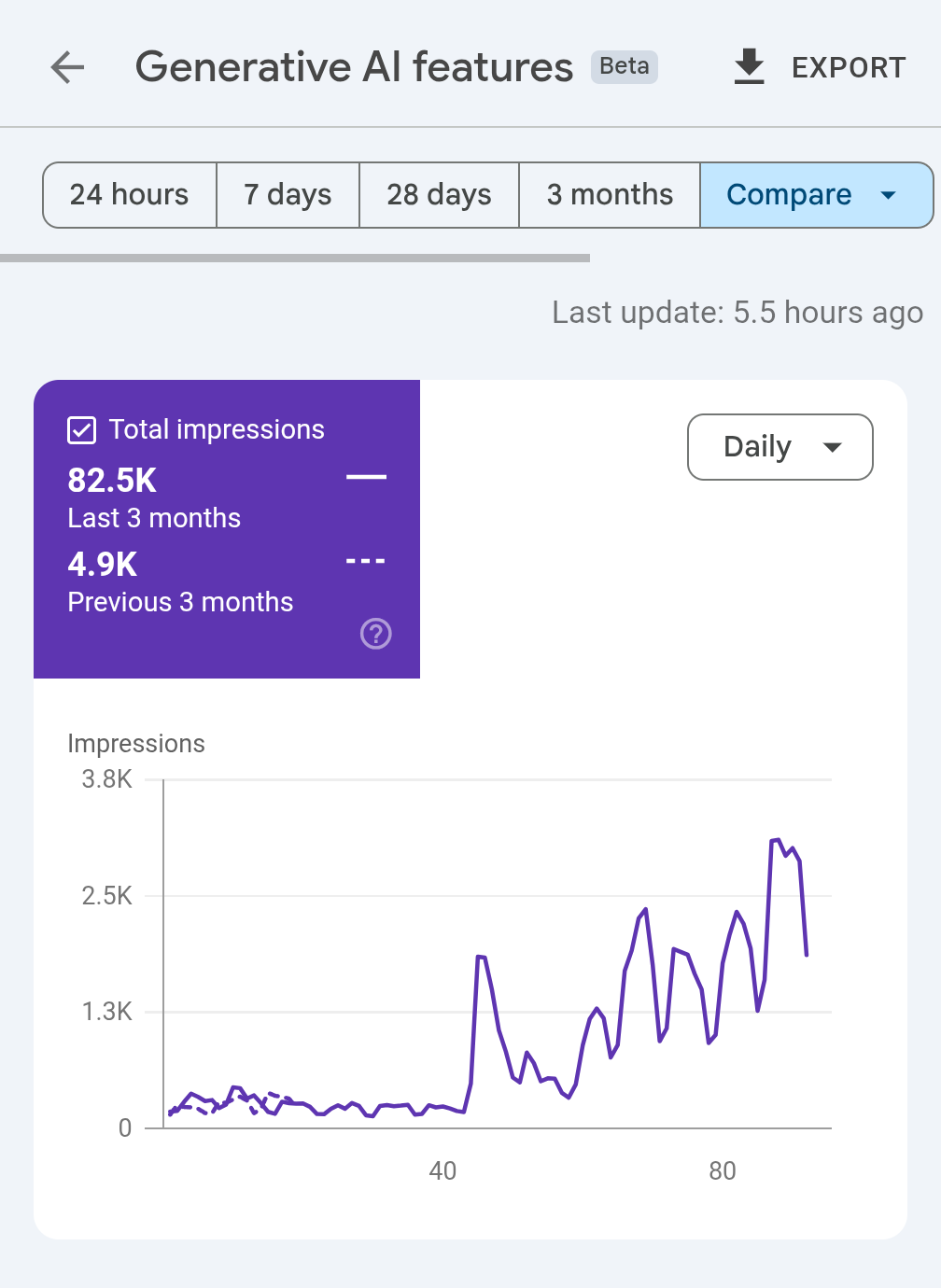
Source: Google Search Console — Generative AI features report, this law firm's own property.
Where Boston Firms Waste the Most Effort
The most expensive mistake is stacking AI SEO tactics on top of an entity foundation that was never actually solid — schema and FAQ content published while the firm's name and phone number still don't match across the web, or attorney bios that list a name and offer nothing beneath it an AI system can verify. With 76,897 attorneys to choose from statewide, an AI system has no shortage of alternatives to cite instead; when the foundation itself is the real problem, AI website design for Boston law firms is usually the faster fix.
Second is publishing content that could describe any American city — no Massachusetts court names, no BBO-aware framing, no reference to what's actually happening in Kendall Square — which AI systems are increasingly good at spotting and quietly ranking below content that actually demonstrates it knows the market.
Third is giving up too early. AI SEO gathers momentum the same gradual way traditional SEO always has — nothing about it moves overnight. A firm that adds schema, ships a handful of genuinely solid pages, sees nothing dramatic after six weeks, and walks away is almost always quitting one stage before the compounding effect it was waiting for actually kicks in.
The Website Underneath All of This Still Has to Hold Up
Pour a strong SEO strategy onto a site that's slow or structurally weak, and there's a hard ceiling on what it can ever achieve, no matter how good the writing is above it. That's the reason this page is meant to run in tandem with AI website design for Boston law firms, not get bolted onto whatever site a firm happens to already have.
If the underlying site is already in good shape, there's no reason to hold off — go straight to the SEO work. Still not sure which side needs attention first? The Boston AI growth hub walks through how to tell the two apart.
Related Reading: AI SEO Insights
From My Experience — James Harmiden
I keep a running list of numbers that change how I think about a market, and 76,897 sits near the top of it now. That's not a statistic I pull out to sound impressive on a sales call — it's the actual size of the field a Boston firm is competing in, and it's why I tell firms here something I don't say quite the same way anywhere else: you are not one of a handful of realistic options in an AI system's eyes right now. You're one of dozens, maybe hundreds, and the system is going to name a small number of you and ignore the rest.
What gives me real confidence working in this market is how little of it has actually caught on to what earns that citation. I look at Boston firm after Boston firm with a genuinely strong reputation and a website that tells an AI crawler almost nothing verifiable about who they are. That's not a knock on the lawyers. It's a gap nobody's shown them yet, in a state where the legal profession is old enough that "we've always gotten clients through referrals" was true for most of a career.
The Kendall Square angle is the part I find genuinely exciting to work on. Watching Biogen and Takeda build out new headquarters while the broader biotech industry works through a rough funding stretch tells me exactly where the next wave of employment and non-compete work is coming from — and almost nobody's writing for it yet. That's the kind of opening I built Lexscale.ai to find for a firm before their competitors even notice it exists.
— James Harmiden, Founder & CEO, Lexscale.ai