Real results from a Toronto law firm engagement, built on the same system we bring to Barrie — read the full case study →
Most Barrie Law Firm Sites Weren't Built for This
Walk through a handful of Barrie law firm websites and a pattern shows up fast: either a generic legal template with a logo dropped in, or a site that reads like it was written for a downtown Toronto audience and had the city name swapped. Neither has what an AI crawler actually needs to understand who a firm is, what it practices, and why it should be trusted — clean semantic structure, real schema markup, and load times that don't lose a visitor before the page finishes rendering. See why law firms need AI-optimized websites in 2026 for the fuller picture of why this shift matters.
This page is about what an AI-optimized site actually requires, and how it feeds into AI SEO for Barrie law firms — the part that determines whether anyone finds that site at all.
Template Website vs. AI-Optimized Website
A site that quietly reuses Toronto content with the city name changed doesn't fool an AI system any better than it fools a client from Innisfil who knows exactly what generic looks like.
James Harmiden · Founder & CEO, Lexscale.ai
What "AI-Optimized" Actually Means Here
The premise is simple: an AI crawler and a stressed prospective client both need to understand, fast, who you are and why you're credible. That means one clear H1 that says what the page is actually about, headings that mean something, and structured data spelling out your firm's name, practice areas, and service area instead of making a machine guess from prose.
It also means real depth on the things that actually bring Simcoe County clients to a lawyer — a real estate closing near Barrie South GO, a Lake Simcoe Protection Act permit question, a family matter that started somewhere in the GTA before the family moved north. A single paragraph under a practice-area heading doesn't give an AI system enough to cite confidently, and it doesn't give a worried person enough to trust you either.
Speed Isn't Optional
Every other improvement on a Barrie firm's site is wasted if the site itself loads slowly. Core Web Vitals are a direct Google ranking factor, and AI systems crawl slow sites less often and less thoroughly — which means less of your content ever gets read in the first place.
Most older law firm sites in this market are running on a content management system carrying a decade of plugins nobody remembers installing. An AI-optimized rebuild strips that out entirely and starts from code built for one purpose.
Structure That an AI System Can Actually Follow
AI systems build their understanding of a site from its structure, not just its sentences. That means one H1 stating the page's actual topic, real H2s marking genuine sections, and internal links that connect ideas the way a knowledgeable person would — a real estate page linking to a Lake Simcoe permit FAQ, which links to a closing-costs breakdown — so the whole thing reads as one coherent body of expertise rather than a pile of disconnected pages. How many pages a Barrie law firm website should have covers what that structure actually needs to include.
It also means keeping critical information — firm name, practice areas, service area, phone number — in the page's actual HTML, not buried inside JavaScript a crawler might not fully render.
Schema Markup for a Barrie Firm
Schema markup is the structured layer that tells search engines and AI systems exactly what a page contains, instead of leaving them to infer it. For a Barrie firm that typically means LegalService schema for the firm itself, Attorney schema for each lawyer with sameAs links to their Law Society of Ontario listing and LinkedIn, FAQPage schema matching whatever's actually visible on the page, and BreadcrumbList schema clarifying how the site is organized.
This is one of the most consistently skipped pieces of a law firm website in this market, and it's also one of the highest-leverage — see what schema markup is and why a Barrie law firm's website needs it for the full breakdown. A properly schema-marked site gives an AI system the exact facts it needs to trust an entity, which is a large part of whether it gets cited. It overlaps directly with AI SEO strategy, since schema sits right at the seam between technical architecture and visibility.
Designing for a Client Base That's Half New to the Area
A meaningful share of Barrie's growth is people who moved here in the last few years, which means a meaningful share of a firm's website visitors have never worked with a local lawyer before and have no existing trust to lean on. That raises the bar on every page: clear, low-friction contact options, credentials placed where a hesitant visitor actually looks for them, and case-results language that stays inside what Law Society of Ontario rules actually permit.
It also means not assuming every visitor grew up here. Someone who just moved from Brampton or Vaughan is Googling the same way they always have, and a site that reads as generic and unspecific gives them no reason to believe this particular firm knows the area any better than the one they left behind.
The Georgian College Audience Almost Nobody Writes For
Georgian College's main campus sits on the northeast edge of Barrie with more than 13,500 full-time students, over 5,500 of them international students from 92 different countries. That's a specific, high-volume audience with its own recurring legal questions — lease disputes with off-campus landlords, work-permit and study-permit issues, roommate conflicts that turn into small claims matters — and almost no local firm has a page built for any of it.
A site with even one genuinely useful page on off-campus tenancy rights for Georgian students, written specifically and honestly rather than as a generic "landlord-tenant law" page, is speaking directly to thousands of people a year that most competing sites never mention by name.
Mobile Isn't a Secondary Experience Here
A large share of legal searches in Simcoe County happen on a phone — during a commute down the 400, in a parking lot after a stressful appointment, on a couch in a house that closed six months ago. A site built for a desktop monitor and merely "responsive" on mobile creates friction at the exact moment a visitor has the least patience for it.
Mobile-first design means the phone number is tappable and visible without hunting, the contact form is short enough to finish with a thumb, and nothing requires pinching or zooming to read. For a Barrie firm this is directly tied to how much of the traffic an AI SEO strategy earns actually turns into a booked consultation, because so much of that traffic never touches a desktop at all.
Compliance Built Into the Build, Not Bolted On Afterward
Every element of a Barrie firm's website — case results, testimonials, anything a chatbot says about itself — needs to hold up against Law Society of Ontario advertising rules before it goes live. A generalist web designer who's never built a law firm site has no particular reason to know that, and it shows up later as a redo nobody budgeted for. The Barrie AI growth hub covers what that compliance standard actually looks like in practice, beyond just the website.
Building that review into the process from day one is cheaper than fixing it after launch, and it protects a firm from marketing claims that don't actually hold up.
The Highway 400 Widening Is Already Generating Its Own Search Volume
The province is widening Highway 400 through Barrie as part of a $30 billion transportation push, and the Dunlop Street bridge is being rebuilt to make room for it. That kind of project doesn't just move traffic — it triggers property questions along the corridor, from expropriation and right-of-way disputes to construction-related claims from businesses affected by years of roadwork.
Almost none of that is reflected in local firm content yet, because the project is still unfolding. A firm that builds a page now, before the searches spike, has a real head start over one that waits until a client is already calling about it.
The Mistakes We See Most Often in This Market
The most common one is content that's factually about a different place — Ontario legal information that never actually engages with Simcoe County specifics, or worse, content lifted from a Toronto-market site with the city name swapped and nothing else changed. AI systems increasingly notice when content doesn't match the market it claims to serve, and it costs a firm citation rather than earning it — the same pattern covered in is my current Barrie law firm website losing me clients, and the mechanics of how that citation decision actually gets made are covered on AI SEO for Barrie law firms.
The second is inconsistent contact information between the website, the footer, and Google Business Profile — a different phone number here, an old address there. It's a small thing that quietly undermines the entity trust both traditional SEO and AI citation depend on.
The third is schema markup that was implemented once and never touched again as the site's content changed around it, so it no longer matches what's actually on the page.
The fourth, and the one firms underrate the most, is a thin attorney bio page. A real bio with sameAs links to a verifiable Law Society of Ontario profile does more for both citation and client trust than most firms expect from a single page.
What This Actually Returns
Directly: fewer visitors bouncing off a slow page, more of them booking a consultation because the path to contact is obvious, and a technical base that makes every dollar spent on SEO afterward go further, because the content it produces finally has somewhere structurally sound to live.
Less directly: durability. A site built on lean, purpose-built infrastructure with real schema markup ages better than a template, because the fundamentals it's built on — speed, clarity, structured data — don't change even as specific AI platforms come and go.
And in a market where a large share of new clients are comparing firms with no prior relationship to fall back on, a noticeably faster, clearer site becomes a real, if quiet, reason to pick one firm over another that looks fine but loads slowly.
Case Study · Toronto Law Firm
From a 140-Page WordPress Site to a 570-Page AI Legal Website
This is a Toronto engagement, not a Barrie one — we don't yet have a published Simcoe County case study — but it's the same system we'd bring to a Barrie firm. Lexscale.ai transformed this law firm's website from an approximately 140-page WordPress website into an approximately 570-page AI-ready legal website, adding practice-area depth, supporting legal insights, service-area content, legal calculators, interactive guided wizards, structured data, and strategic internal linking, on faster, purpose-built infrastructure.
The result: organic website traffic tripled within 90 days. Results vary by firm, market, and existing authority — but a Barrie build follows the identical process, adapted for Simcoe County's market and Law Society of Ontario compliance.
Since then, this same law firm's visibility in Google AI Overviews has grown from 4.9K to 82.5K impressions in 3 months — verified directly in Google Search Console.
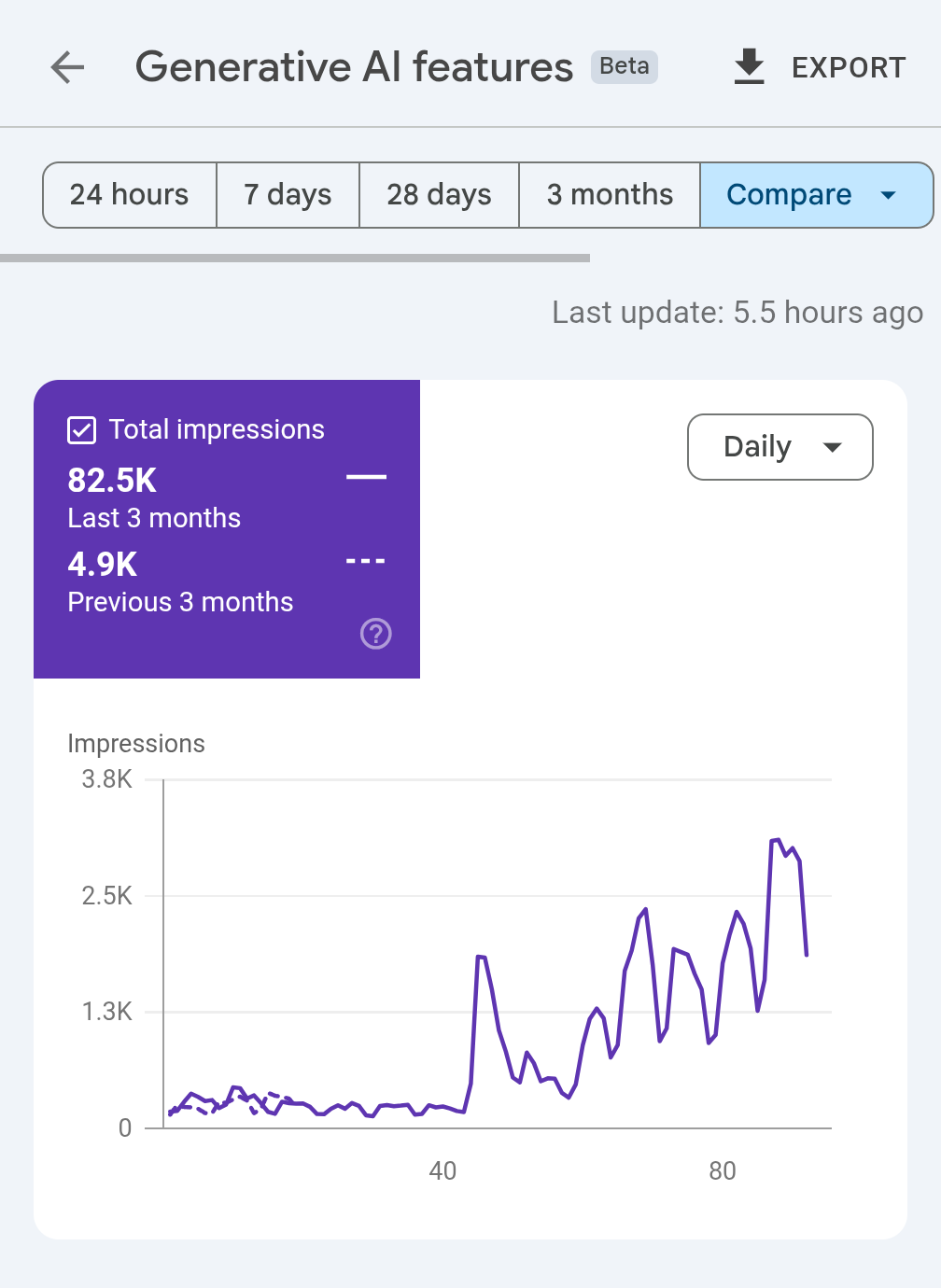
Source: Google Search Console — Generative AI features report, this law firm's own property.
What to Expect in the First 90 Days
A Barrie build has one wrinkle most cities don't: a lot of firms here serve clients across all of Simcoe County, not just the city itself, so the site has to read as county-wide from day one rather than narrowly local. If you're planning around a timeline, how long an AI-optimized website build actually takes in Barrie walks through each phase below in more detail.
Launch is usually the starting gun for an ongoing AI SEO engagement, not the finish line — a brand-new site with nothing pointing at it yet gets the most out of a coordinated push in those first few months.
How the Build Actually Runs
Every engagement starts with an audit of the current site against the standards above, then a strategy call to set priorities. From there Lexscale.ai handles design, build, schema implementation, and Law Society of Ontario-compliant copywriting directly — the same process behind our broader AI website design work across North America, adapted for Barrie and Simcoe County specifically.
Most engagements move from first call to a fully launched site within a few weeks, then continue into AI SEO and ongoing content work. For the broader picture before committing to a website build on its own, start at the Barrie AI growth hub.
Related Reading: AI Website Design Insights
Barrie Insights: Questions Answered Directly
From My Experience — James Harmiden
I've rebuilt a lot of law firm websites over the years, and the ones in growing markets like Barrie usually have the same story: a site that was perfectly fine for a town half its current size, now trying to keep up with a city adding tens of thousands of new residents a year. Nobody rebuilt the site to match. It's still the same WordPress install from years ago, still slow, still structured for a search landscape that doesn't exist anymore — the exact migration is covered in how to move a Barrie law firm website off WordPress without losing your Google rankings.
That mismatch matters more here than people realize. A firm in a fast-growing market like Barrie doesn't just need a website that looks fine — it needs one that can actually be read and trusted by AI systems fast enough to keep pace with how quickly the client base itself is changing. I've seen firms lose ground not because a competitor outspent them, but because their own site was quietly the slowest, least structured one in the county.
What I push for with every Barrie rebuild is the same thing: strip out what a WordPress site accumulates over the years, build something fast and properly marked up from the start, and get better results than what the firm was already paying for — often for less than it was spending before.
— James Harmiden, Founder & CEO, Lexscale.ai